The University of New Hampshire and the Demographic Cliff
Most recently I’ve read with fascination about Syracuse University’s troubles and how large and mid-sized schools might be impacted by the demographic cliff.
I had to ask myself: are there flagship state schools that have smaller undergraduate student bodies than Syracuse, have reasonable acceptance rates, and are facing enrollment challenges?
I thought of one such school that recently had a program on The College Tour: the University of New Hampshire (UNH) I realize that College Tour programs sound overly scripted. But this one showed the campus quite well. I also invite you to check out my UNH Pinterest page.
Founded in 1866 the University of New Hampshire (UNH) UNH is not only a Federal Land Grant institution; it’s also a designated Sea Grant and Space Grant University. With fewer than 11,500 undergrads, UNH is one of the smaller flagship state schools in the US. Only three, the University of Idaho, University of Maine and the University of Wyoming have fewer undergrads.
UNH’s sticker price is high as flagship state schools go.
But It’s possible for your cost of attendance to be less than a private research university like Syracuse will charge for tuition and fees alone. And someone who might get into Syracuse or UMass-Amherst could get a merit award that they might not receive from those schools. The award will definitely help.
The New Hampshire Bulletin published a story before the start of last academic year that spelled out reasons why UNH’s in-state charges are high for a state university.
Non-resident tuition and fees are approximately double resident charges. They’re less than UConn, UMass-Amherst or Penn State would charge non-residents Aside from the flagship needing non-residents to fill the student body, the fiscal state of the Granite State is not great and the state has the second-oldest population (after Maine) as well as the lowest wages in New England. Furthermore, the neighboring states are in the same financial and demographic boat.
I honestly wonder why UNH does not get the interest that it should.
I understand that UNH is not as high profile as other state schools that have stronger mystiques, especially if they play in a high-profile sports conference. But UNH checks a lot of boxes in terms of what many students want. There are more academic options than most would expect; only nursing pushes for direct admission. Poets & Quants for Undergrads ranked the business school 58th, ahead of the University of South Carolina and UConn. I was also impressed by the animal science and marine science programs as well.
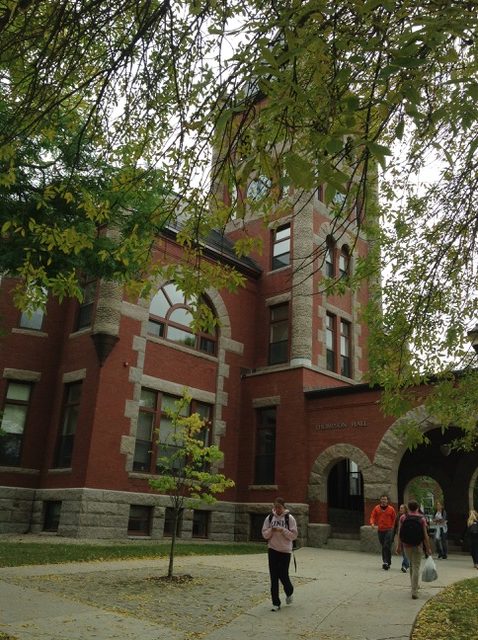
UNH also has an attractive, less intimidating campus to navigate than most other flagships. Beauty is in the eyes of a beholder, but I find UNH to have a more attractive campus than Syracuse as well as UConn or the U of Rhode Island. The University of Vermont has similar assets though it’s also close to Lake Champlain
UNH is about as close to Boston as Rutgers is to New York City, and closer to beaches and mountains, too. It’s actually closer to the Hub City than UMass-Amherst–and you can’t get from that school to Boston on one train ride. as you can from UNH
Actor Adam Sandler wore a UNH t-shirt in a 2010 movie, Grown Ups.
However, while Sandler is a New Hampshire native, he went to NYU. So, UNH cannot play on a relationship with this favorite son of the Granite State. The parents of prospective UNH students who are Red Sox fans might know that Hall of Fame catcher Carlton Fisk is a UNH alum. However, Fisk was drafted after his sophomore year and never graduated. Hockey Hall of Famer star Rod Langway also played for UNH. However, like Fisk, he didn’t graduate. This school could really use a spokesperson. Author John Irving went to UNH. But parents will know his works much better than prospective students. Five of Irving’s books were adapted for movies, but the last movie was aired two decades ago.
Admissions to UNH are more achievable than they are at UConn, UMass-Amherst, and the University of Vermont.
The acceptance rate has been over 85 percent for the past ffive cycles on record. That’s really high at a time when UConn, UMass-Amherst, and the University of Vermont have become more selective and attracted more out-of-state applicants.
The university committed to test-optional admissions in Fall 2019, just before the Great Pandemic hit college campuses. Less than a fifth of applicants to the Class of 2028 submitted scores. Among those who did, most submitted SATs. The middle 50 percent scred between 1090 and 1330. That’s below the ranges for UConn, UMass-Amherst and UVM as well as Rutgers-New Brunswick.
A “bread and butter” student at those larger state schools might be a candidate for the Honors College at UNH.
The university is moved from an honors program to an honors college, much like UMass-Amherst, UVM and Rutgers, expecting to welcome 250 to 300 students each fall. Their inaugural class had 322. That will be about 10 % of a freshman class. as well as 10% of the full undergraduate student body, including those who are admitted later in their education. That’s about the same number at the Schreyer Honors College at Penn State-University Park, a school with over 40,000 undergrads..
The “look and feel” of UNH is much like UConn.
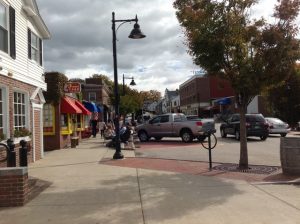
Both universities have very walkable campuses, mascot statues by the main sports venue, and locally produced ice cream. The surrounding downtowns are smaller than students, employees and guests would expect from a flagship state school. I dropped a photo of downtown Durham below. It’s quaint and there are student-oriented coffee shops and dining places. But the selection is quite small for a college town.
Unlike most state universities, UNH and UConn house the majority of their students and off-campus living options are quite expensive nearby. Both have the same percentage of students engaged in Greek life (14 percent) There’s a lot of academic overlap, in part because both universities are Land Grant schools.
But UNH is also less isolated than UConn.
It’s only an hour from Boston or Portland, Maine and closer to mountains and beaches. There’s an Amtrak station on campus where trains leave for both cities six times a day on weekdays and five times daily on weekends. Trains are three hours apart, so a commute to Boston more than two or times a semester is not practical. However, UNH also has a 16-credit Semester In The City program for students who are interested in social change. There’s another program, Semester for Impact, where students can opt to stay in New Hampshire. Both programs include an internship with a for-profit business or a non-profit organization.
UConn has the sports profile which helps in admissions.
UConn has been a nationally dominant player in men’s and women’s basketball as well as men’s and women’s soccer. UNH plays these sports in America East, a conference with a much lower profile. UConn also competes in more sports (21 vs. 19). You’re far more likely to meet UConn fans at a basketball watch party in any city than UNH fans for any sport.
UNH has had the better football program. From 2004 through 2017 the UNH Wildcats made the playoffs every season, though they did not get past the quarterfinals. Former NFL, Oregon and UCLA head coach Chip Kelly got his start at UNH. He played defensive back for the Wildcats. Kelly’s coaching career includes 13 seasons as an assistant at his alma mater, the last eight as offensive coordinator. Ohio State head coach Ryan Day is also a UNH alum. He quarterbacked for the Wildcats for Kelly from 1998 through 2001. Day was recently inducted into the UNH Athletic Hall of Fame.
UNH also has the stronger men’s hockey program. While neither the men nor the women have won a national championship, the hockey programs were quite competitive through the 2000’s and into the 2010’s. According to the NCAA, the men ranked 13thnationally in home attendance this season, averaging over 5,000 fans per game in a venue that seats just over 6,500. During the past season the hockey Wildcats outdrew larger schools such as Ohio State, Boston University and Cornell.
Unlike other flagships, applications to UNH have not taken off on a ‘hockey stick’ trajectory.
Applications rose from 19,000 in 2014 to 22,100 in 2021. They’ve stuck around 22,000 for four cycles. That’s not a major climb considering that UConn, UMass-Amherst and the larger Boston colleges have become more selective. The size of the incoming freshman class actually declined from more than 3,900 in 2014 to 3,100 this past fall. The yield rate, the percentage of accepted students who decided to come, dropped from 25% to 14%.
Forty years ago, UNH attracted just under 40% of its students from outside the Granite State. By 2015 over half were non-residents. As undergraduate enrollment has dropped from 12,600 in 2014 to 11,300 in 2025, UNH now gets 53% of the population from other states. Massachusetts is the largest sending state, filling about 30 percent of the population. It’s followed by Connecticut, Maine, and New York, all states with declining high school age populations.
While undergraduate enrollment has dropped freshman retention has held steady.
Retention has been between 85% and 87% since 2014. Over two-thirds of every freshman class that entered from 2014 to 2019 graduated in four years. Graduation rates for the more recent classes exceeded 70%. That’s quite good considering the loss after the first year.
Access to undergraduate research at UNH is better than it will be at larger schools such as UConn, UMass-Amherst or Rutgers-New Brunswick.
The university’s Hamel Center for Undergraduate Research is one of the longest standing programs of its kind at a state university. The university’s two-week long Undergraduate Research Conference is held every April. It attracts as many student participants as you might find at a much larger state school.
Conclusions
In many ways it’s hard to fault UNH. Admissions are quite achievable unless you want to be a nurse. It’s quite possible to get a more personal educational experience here than you would get at most other flagship state schools, or at Syracuse. For those who want a larger school that isn’t a “mega-versity” with over 35,000 students and like the idea of being close to larger cities, mountains and beaches, UNH is well worth a look., especially if the costs will work out
Report Card-University of New Hampshire
- Four-Year/Six Year Graduation Rates: A/A
- Freshman Retention: B+
- Costs: C
- Curriculum: A
- Community: B+
- Comforts: B+
- Connections: A (Boston/Portland ME)/B (NYC/California/DC/Florida)/C (elsewhere)