SUNY-University at Buffalo and the Demographic Cliff
SUNY University at Buffalo is probably one of the best values among flagship state universities. However, New York is one state expected to be hit hard by the demographic cliff. This means that fewer high school graduates will be entering two and four-year colleges within their state university system.
This school has a lot to offer, though it has a low profile for a flagship public research university. I made a Pinterest page after my last visit that you can check out.
Can SUNY University at Buffalo weather the demographic cliff?
Long term, the challenges for this school are to maintain market share within New York State and attract more out-of-state students since international undergraduate enrollments are likely to continue to slip.
So, I decided to take a longer look at SUNY-University at Buffalo. It has a combination of affordability and academics that parents and politicians like. However, it doesn’t have the brand recognition of the flagships in neighboring states: Connecticut, New Jersey, Massachusetts, Pennsylvania, and from across Lake Erie, Ohio. The university’s athletic program and traditions are lower profile, which impacts recognition. So does the lack of natural rivals to help fill the seats.
With nearly 21,000 undergraduates SUNY-University at Buffalo is the largest of the system’s four flagship campuses.
- Enrollment has taken a slight dip since 2020 when more than 22,000 were enrolled.
- Freshman retention has declined slightly, according to the university, from 87% to 85%.
- Last year, SUNY-University at Buffalo welcomed over 5,100 freshmen.
- However the acceptance rate to fill the class has risen from 60% in 2015 to 81% today.
- The yield rate dropped from 26% to 14%.
Although SUNY-University at Buffalo is not exceptionally selective, standardized test scores are considered to be Very Important ,if submitted. The middle 50 percent for those who submitted SAT scores was between 1230 and 1390. That’s lower than ranges for Penn State-University Park, Rutgers-New Brunswick, UMass-Amherst and the University of Pittsburgh. The average GPA was just below 92.
This school is a good value for the money and should remain that way.
- The estimated resident cost of attendance for the academic year just concluded was approximately $35,900. Tuition and fees were just over $11,000. That’s lower than resident charges for any flagship in any neighboring state.
- The estimate for non-residents was approximately $57,400. Tuition and fees were $32,500. These charges were the lowest for any flagship in the Northeast and Mid-Atlantic states, with the possible exception of the University of Maine, which has an aggressive program called Flagship Match.
- There are merit scholarships targeted at resident, non-resident and international students. About a quarter of the Class of 2029 received a merit scholarship that averaged just under $4,600.
- Forty-five percent of 2025 graduates had no student loan debt.
While the charges are reasonable and the academic offerings quite broad, only 4% of the university’s undergraduate students come from other states. The percentage of international students is actually higher, although those numbers declined slightly from 2022 to 2025.
This school houses nearly 40% of its student body on campus, a higher percentage than most flagship state schools. The selection of living options includes residence halls and apartments. They’re supported by an impressive selection of living-learning communities. Greek life is not especially popular, engaging only 3% of the undergraduate student body.
The hurdles to get into high demand majors are not as high as other schools.
There are special requires for entry into five programs. Accounting and business are considered to be “limited enrollment” programs Business students are expected to be calculus ready. Engineering candidates will go through an additional review for math and science. The path to a PharmD has additional requirements as well. Oddly enough, there were no special requirements listed for nursing. This school does a good job explaining exploratory paths.
One area where SUNY-University at Buffalo stands out among flagships is Finish in 4.
Those who sign a pledge to finish their degree on time receive added benefits. This is an interesting version of a priority registration program for students who have a firm idea of their intended major.
What might be the most comparable university?
Based on the schools that I have visited–and I’ve been to this school-and reviewed, I would say the University of Iowa.
- Both schools are members of the Association of American Universities. Only 38 state universities are members of this body, based on their research accomplishments. Both have medical schools, which contributes significantly to research output.
- They have about the same number of undergraduates (22,000 to 23,000)
- Academic offerings are similar; neither is the Land Grant university for their state. One difference is Architecture, which is not offered at Iowa.
- There are significant efforts to keep these schools affordable to resident students.
However, there are also significant differences.
- Iowa does better at retention (90% vs. 85%) and at graduating students over four years (66% vs. 58%)
- While both campuses are stretched out over a colder weather city, Ithe Iowa campus has more of a walk into downtown feel.
- Iowa has a far more visible sports profile, competing in the Big Ten, especially with successes in football, wrestling and women’s basketball. Buffalo and UMas-Amherst are the only flagship universities in the Mid-America Conference.
- SUNY-University at Buffalo offers many combined degree programs including engineering with the MBA, as well as accelerated from the College of Arts & Sciences, School of Public Health, and the School of Management.]
- This SUNY school has a smaller honors college population (1,650) than either Iowa or UMass.
SUNY-UNiversity at Buffalo is split into three campuses.
The North Campus, where most of the residences are located and most of the academic activity happens, was first completed in that early 1970s. While new buildings were added over the next four decades, the academic center of North Campus appears to be one brown concrete “super-block.” The landscape of the campus, including the Baird Point lakefront and Lake LaSalle is manmade. The entire North Campus is very easy to navigate with academic buildings at the center, then parking, then athletic facilities, residence halls and apartments at the outer ring. Some academic buildings are connected by walkways, useful in the colder months. I found some North Campus photos from the university’s collection and dropped three below.



The South Campus is the original campus originally constructed during the 1920’s. It has more of a “college feel” and is closer to Buffalo’s downtown. The medical school and biomedical research center are based downtown. I dropped two South Campus from the university’s collection below.
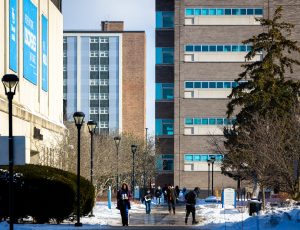
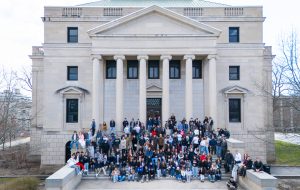
Beauty is in the eye of a beholder when visiting college campuses. I watched several short YouTubes that highlighted various student-friendly improvements to the North Campus since I last visited. Building interiors felt more people friendly. Honestly, however, it resembled conference rivals Kent State and UMass-Amherst far more than Ohio State among the schools that I have visited.
One of the best reasons to consider UB might be the City of Buffalo.
The second more populous city in New York, with nearly 280,000 residents, Buffalo has many amenities found in larger cities. These include:
- Professional football and hockey, minor league baseball.
- A strong core of entertainment including music, theatre, and over 50 art galleries (,ncluding the Albright-Knox Gallery, the first modern art museum in the United States,
- America’s third-oldest city zoo.
- Hiking and skiing opportunities less than an hour from campus.
- Close proximity to beaches along Lake Erie and has attractive boating options.
More important, the university is the dominant institution in the city, much like Ohio State in Columbus or the University of Minnesota-Twin Cities.
Students will face less competition for internships, part-time career related positions and summer jobs in the Buffalo area than they would in cities such as Boston, NewYork, Philadelphia or Pittsburgh. In addition ,students can explore Buffalo and the surrounding area either by car or mass transit from campus.
If SUNY-University at Buffalo were a member of the Big Ten, it would be the fifth most populous community after Los Angeles, Columbus, Minneapolis and Seattle. If one wants to consider Evanston (Northwestern) part of Chicago, it would be sixth. Within the Mid-America Conference, Buffalo is the largest media and sports market.
Conclusions
SUNY-University at Buffalo has the academic offerings and competitive pricing that many seek from a flagship state university. although it doesn’t have the brand recognition that goes with having a high-profile athletic program. I can’t see enrollment dropping far, given the academics and costs, but this campus is a tough sell to US residents who are not from New York.
Report Card: SUNY-University at Buffalo
- Four-Year/Six-Year Graduation Rates B+/B+
- Freshman Retention: B
- Costs: A
- Curriculum: A
- Community: B+
- Comforts: A
- Connections: A