Getting To Know: Hampshire College (MA)-A School That’s Closing
I paid my first visit to Hampshire College in ten years on route to attend a college tour program in Worcester..My visit took place on a Saturday when the college had a very approachable admissions officer to host the information session as well as three students who have benefited from the experience and stumbled into a birthday party for alumni.
Sadly, as I post this today, Hampshire College announced that it will close after the conclusion of the Fall 2026 semester. There will be a commencement as well as attempts to “teach out” the students who need the summer and fall to complete their degree. Others in their first through third years will have transfer pathways into partner schools, including their neighbors Amherst College, Mount Holyoke College, Smith College and the University of Massachusetts-Amherst.
Hampshire had gone through ups and downs since my first visit.
I had to do a lot more reading and listening after I visited Hampshire College to better understand the school. This included watching a documentary, The Unmaking of a College,set seven years ago when the college was on previously on the brink of closing, among other YouTubes. .The documentary title might have come from a 1967 report, The Making of a College. That report formed a basis for the school’s founding. It was later updated in 1975.
Hampshire’s academic model was sound.
Going to Hampshire College has been like jumping from high school to graduate school, without a structured college education in between. Hampshire has been a place where one can figure out how to solve the problem, then test their proposed solution on a small scale. Current students and alumni were probably more responsible for the direction of their education than students at virtually any liberal arts college that does not have an open curriculum.
While the academic model was a draw, Hampshire lost about 25% to 30% of a freshman class each year.
The most recent four-year graduation rate that I could find was 47%. I was also told that it was common for students to leave, take time off, then return to finish their education. However, those numbers also showed me that most who left never returned.
Hampshire has had an open curriculum organized around Divisions.
There are no formal majors nor formal grades. Students took responsibility for working with faculty advisors to design their own academic program and receive written evaluations. But it has been possible to fail a course at Hampshire through an exceptionally negative evaluation. Hampshire courses are niche oriented versus the same class being offered each year.
Here are some other aspects to the curriculum
- Hampshire offered academic level courses; some had prerequisites. But these could be courses taken in high school.
- There were no limits as to the number of independent studies that a Hampshire student could take.
- Small classes were the rule, typically 12 to 15 students. Outside of courses at the other Five Colleges, a Hampshire student was not likely to have more than 40 students in a class on campus.
I felt that a Hampshire faculty member needed to have stronger interpersonal gifts than at other colleges to convey a fair evaluation and to get to know peers at the other colleges in the area.
Hampshire College students had the opportunity to choose from over 9,000 courses in the immediate area, including study abroad.
This included offerings at the rest of the Five Colleges: Amherst, Mount Holyoke, Smith and the University of Massachusetts-Amherst to design their degree program, provided that they could line up the bus schedule and their class schedules. Buses arrived on campus every 20 to 30 minutes from campus during the week to ferry students into the community as well as classes. Nearly 90 percent of Hampshire students took at least one class at one of the other Five College schools. Hampshire students who took courses at the other four colleges received traditional grades in those courses.
Within the exception of intercollegiate athletics, Hampshire students could participate in any activity, club or organization on the other campuses. Halloween has been the biggest attraction for the students from the other colleges to visit Hampshire. outside of classes.
Hampshire’s academic model produced an impressively creative alumni base for a fairly young school.
A “Div III” senior project could be a performance, a literary work, a deep academic study, business plan, and more. T The admissions office also sharedsome examples. (photo below) for visitors. Students who finish their Div III ring the Division Free Bell on campus to salute their accomplishment.

Hampshire College also had a unique admissions process.
The college was “test blind.” There was no need to submit ACT or SAT scores. They were not considered in reviewing applications. But academic performance, creativity graded work and recommendations were considered.
The marketing appeared to connect best with an unconventional student with a non-traditional high school education and/or unique interests. A student with a 3.5 high school GPA, maybe lower, could get in if they showed exceptional curiosity through their creative work.
The campus has its strengths and weaknesses.
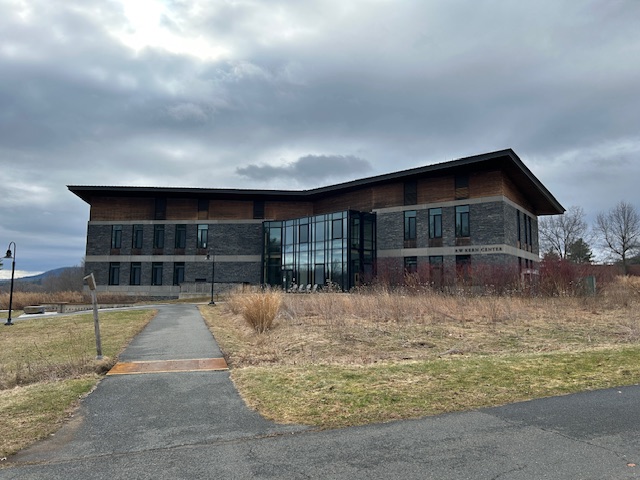
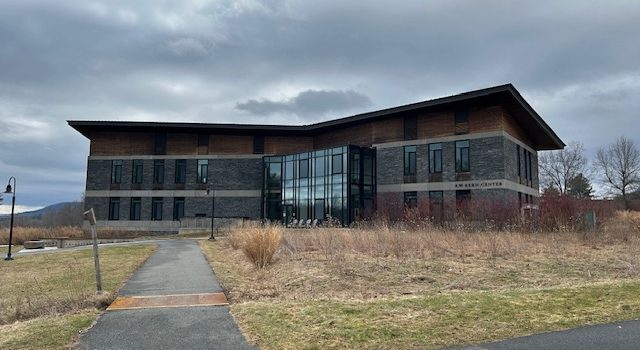
While located in Amherst, one of America’s nicest and probably more liberal college towns, Hampshire has a rural setting on the outskirts of town. The setting is beautiful, while the college is a national model for sustainability. Yet the architectural mix on campus could best be described as eclectic or functional.To me this campus looked like an aging farm and art school folded together. The Kern Center, a Net-Zero building (pictured up top) has probably been the signature building. It best represented the school’s commitments to sound environmental practices.
The residence halls and the design center were quite dated compared with other schools that i have visited. The design center served as a maker space for the arts as well as the sciences. It seemed too small compared to maker spaces at most schools.
A Hampshire student could get a fine education and complete a strong Div III in several areas.
- Visual and performing arts
- Biological and environmental sciences,
- Humanities and social sciences
- Drafting business or strategic plans.
But I also believed that students interested in areas such as chemistry, computer science and physics needed to rely more on resources available at the other colleges or find grants to cover costs for the tools they needed. Then again, so do real researchers who delve into these subjects in real life.
This campus has been quite large given the small size of the student body.
Hampshire has 800 acres. Much of the land is undeveloped. For comparison, nearby Smith College has nearly 2,500 students on a campus of about 150 acres, Hampshire has co-tennants on its land, including an art museum and the Yiddish Book Center. However, Hampshire has too much land and has drawn too little income from it.
Hampshire College could house practically everyone.
First-year aka “Div I” students lived in the residence halls; virtually all got single rooms. Advising not only helped with academics; it also addressedparticipation in student and community-oriented activities on and near campus. Continuing students moved into on-campus apartments, aka “mods” for the remaining three years, exclusive of study abroad or study away within the US. However, all of the housing was aging. The appearance of the first-year residence halls was not a strong point on my tour.
Hampshire tried to help with the costs.
At first glance, this experience looked expensive. Hampshire had planned to charge nearly $63,000 in tuition and fees alone for next year. But the school really tried to help. Now that the college is closing I had to wonder if they discounted aggressively at the expense of upgrading the quality of life and facilities on campus.
I gathered some data from my visit and online after I came home
- Deposited first-year students were offered merit awards between $27,000 and $40,000 each year as well as need-based aid.
- On average, according to the most recent data I could find, Hampshire met 86 percent of estimated need. The average need-based scholarship was close to $50,000 for students who entered in 2024.
- Hampshire reported that 2024 graduates, on average, owed nearly $27,000, the maximum they could borrow over four years from the Federal Student Loan Program.
Seven years ago, Hampshire was in the early signs of serious financial trouble.
The college welcomed only 19 freshmen in 2019 who had been admitted through Early Decision. At the time of my previous visit Hampshire had over 1,300 students, all undergraduates. Two years later there were fewer than 800.
A past president entered into discussions with UMass-Amherst that would have presented unfavorable terms to the college’s trustees. Such an agreement would have likely ended Hampshire’s academic model and identity. Students held a 71-da ysit-in as they sought agency, feeling disengaged from decision making. Parents and alumni pushed back as well. Enrollment dropped to 745 for the 2019-20 academic year, dropping to 522 and 472 during the years after that. Hampshire also lost over half of its faculty from 2019 to 2023. Most recently, Hampshire College had 750 students, expecting to welcome 200 freshman this fall.
Thanks to a fundraising drive led in part by alumnus and documentary producer Ken Burns, Hampshire College managed to remain open and independent until now. The campaign raised over $40 million in its first four years alone. As of April 3, 2026 the college had raised $55 million.
However, soon after I left campus I read that Hampshire’s accrediting body, the New England Commission of Higher Education asked the college to “show cause” as to why it should remain accredited. The major issue was financial, a need to reduce operating deficits and refinance a $21 million bond debt.
Conclusions
It has been over 50 years since Hampshire graduated its first senior class, enough time to learn if the college’s educational model worked as its founders hoped. For the most part, the model had produced exceptionally creative and successful graduates. However, this model worked because the students had access to so many resources from its Five College neighbors.
I genuinely feel sad for the Hampshire community. today. After watching The Unmaking of a College I felt that the students, alumni, faculty and staff who bought into the model really cared about this school, even when it was on the brink of its last breath. There’s something to admire about that.
Buy my book, The Good College!
Vote to help me win a publishing contract for my novel, America’s Town!
Listen to my latest interview on ‘Tests and the Rest’ with Amy Seeley and Mike Bergin!
Check out my talk, What Exactly Is a Good College? hosted by test-prep experts Amy Seeley and Mike Bergin on Tests And The Rest!