Getting To Know: Assumption University (MA)
I was not familiar with Assumption University until my Worcester college tour. Assumption has approximately 1,700 undergrads and just over 300 graduate students. It’s a small Roman Catholic university that looks like it’s packing a powerful punch in business and the health professions. The marketing message of Assumption University is In the Company of Friends. Nice people, nice campus do apply to this school.
Assumption University is a regional school that’s not exceptionally selective.
The university accepted over 80 percent off all applicants for the Class of 2028. The majority of the class was admitted through Early Action. The university uses Early Decision, but it does not attract a significant share of a class. While the academic record is considered Important, so are essays and demonstrated interest. Admissions are test blind. The average GPA is a 3.6. Approximately 70 percent of the undergraduates come from Massachusetts.
Assumption loses a little less than a fifth of a freshman class. However, the most recent four-year graduation rate I could find was 70% for the Class of 2024. That’s quite good for a small college that’s not overly selective.
Assumption reports that it offers a Catholic liberal arts education
However, more of the academic programs are weighed towards business, education and the health professions. There’s also multiple options in Criminology. While visiting our tour group learned about the Physician’s Assistant Program, which is relatively new. However, that program does not have an accelerated pathway at this time. The university has 37 majors and 50 minors. All students take a Foundations curriculum that’s built on three Pillars and three Cornerstones. Philosophy and religion are required to earn a degree. So are courses in foreign language.
Here’s a few unique options among majors:
- Accelerated pathway towards a masters in Rehabilitation Education
- Applied Behavioral Analysis dual degree program
- BA in Education/MA in Special Education Dual Degree program
- Clinical Counseling Psychology Dual Degree program
- Human Services
- Marketing with concentrations is Sales and Digital Marketing
- School Counseling Dual Degree program
And there are some interesting minors and concentrations, such as:
- Communication Sciences and Disorders
- Community Service Learning
- Core Texts & Enduring Questions
- Engineering Science
- Fraud Examination and Forensic Accounting
- Law & the Economy and Law, Ethics & Constitutional Studies
- Patient Advocacy
There’s a four-tier approach to advising called Foundations Forward.
Assumption assigns each incoming student an academic advisor, career advisor and alumni mentor. The faculty members act as academic advisors versus the professional advising staffs that work at larger schools. The fourth tier is a small-group (18 – 20 students) residential learning community.
The support structure is more than I’ve seen at many colleges. I felt that it was helpful for students who get immersed in their programs early in majors such as Accounting, education programs and Nursing The graduation rate is a hint that students are less likely to give up on ether the school or an intended major than they would at schools that admit a statistically similar freshman class.
My only concern was that I found through searches that only half of the faculty are full time. I’d believe that others work in the fields that students want to become employed. But it’s fair to ask if those faculty advise as well.
The experience will likely cost more than Home State U.
This year, Assumption University had an estimated cost of attendance of just under $76,000 for an incoming first-year student.. This covers direct costs (tuition & fees, room & board) and estimates for indirect costs such as books, supplies and transportation to and from home.
There are multiple opportunities to reduce costs through merit scholarships that range between $21,000 and $35,000, athletic grants-in-aid ,honors college scholarships and need-based awards. Awards are stackable, rare for any college. It’s wise to apply Early Action; accepted students get the award letter early as well. Awards are fairly easy to keep, requiring only a 2.0 GPA. Our group also saw that award letters were quite readable, easy for a family to understand.
Given what I learned about Worcester State on my five-school visit, I doubted that Assumption could reduce costs down to the level of a regional state college for a Massachusetts resident. That’s going to be true for New Jersey residents, too, given what I know about their costs as a resident of the Garden State. However, it might undercut out-of-state costs for the University of New Hampshire, a popular flagship option for Bay State residents. The college can also accept state scholarship grants from Connecticut, Pennsylvania and Vermont.
While Assumption met, on average, 83 percent of need in 2024, a quarter of the graduating class needed to take out private loans. It’s possible some of the debt went towards a graduate degree in a dual degree program. The average indebtedness of 2024 graduates who borrowed was over $41,000.
Assumption University is built on a hill, but it’s a very navigable campus.
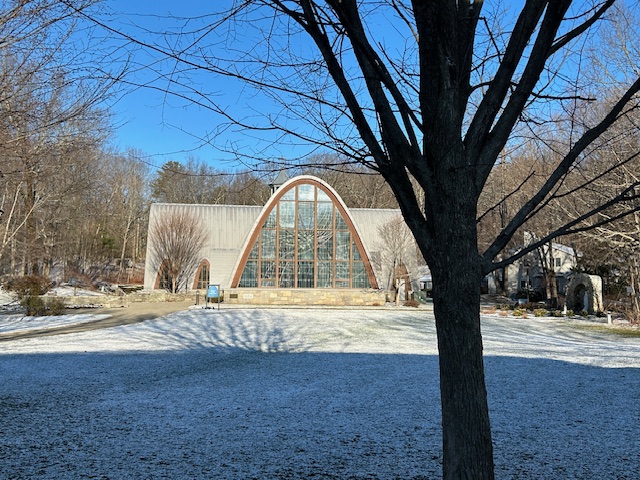
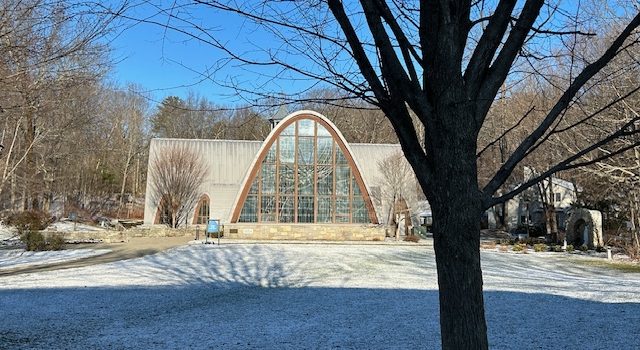
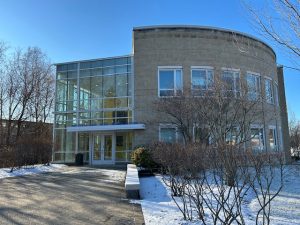
My impression is that the chapel (photo up top) and the health sciences building are really the signature buildings on this campus. The chapel has a nice mix of modern architecture and traditional religious trappings. The academic center and science center are also well designed.
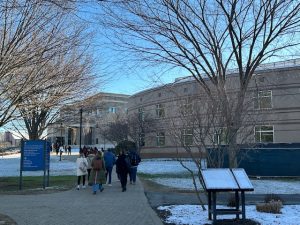
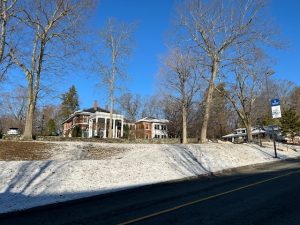
Other Catholic college campuses I have visited continually reminded me that they are Catholic schools. Assumption’s cues are more subdued. I dropped three campus photos below. These are photos of the student center, admissions office and the health sciences building.
Life at Assumption is very campus based. Aside from commuters nearly 80 percent of the students live in university-owned housing. The university has two dedicated first-year residence halls and two others shared with second-year students. Third and four-year students have suite style and apartment style options.
Athletics are fairly important for a small school.
Assumption competes at the NCAA D-11 (scholarship) level., except in women’s ice hockey, where the school is D-1. Nearly 40 percent of the students are varsity athletes. The university competes in 24 men’s and women’s varsity sports, including football. That’s more than many schools with larger enrollments. The football stadium is named for Brian Kelly, an alumnus who was formerly head coach at Notre Dame and Louisiana State University. The university also has a Sports Management minor as well as a partnership with the Worcester Red Sox (WooSox), the Boston Red Sox Triple A affiliate.
Duck Day is the festive event on campus.
In late April the community celebrates the return of the ducks to the campus pond from the farm where they have boarded during the winter. The ducks live on pond for the remainer of the semester, the summer and fall.
Conclusions
Assumption University has a nice student success model that has served its students well to date. The selection of majors is timely with student interests across the region and the country as a whole.
My sense was that families on a state college budget were quite attracted to Assumption., and with good reason. However, I really recommend speaking with the financial aid team before making the commitment to deposit. This school has good ideas and programs but the costs need to work out. It’s fair to ask if they will since at least two other religiously affiliated colleges (Mt. Ida and Anna Maria) in Massachusetts have recently closed. I doubt that Assumption will face a similar fate because it can retain and graduate most of a class. However, I also believe that Massachusetts parents read and hear about these closings in their media.
Report Card: Assumption University (MA)
- 4-Year/6-Year Graduation Rates: A/A
- Freshman Retention: B
- Costs: B+
- Curriculum: A
- Community: B+
- Comforts: A
- Connections: A (Massachusetts)/C (elsewhere)
Learn more about my college, graduate and professional school admissions advisory services.
Buy my book, The Good College!
Vote to help me win a publishing contract for my novel, America’s Town!
Listen to my latest interview on ‘Tests and the Rest’ with Amy Seeley and Mike Bergin!
Check out my talk, What Exactly Is a Good College? hosted by test-prep experts Amy Seeley and Mike Bergin on Tests And The Rest!