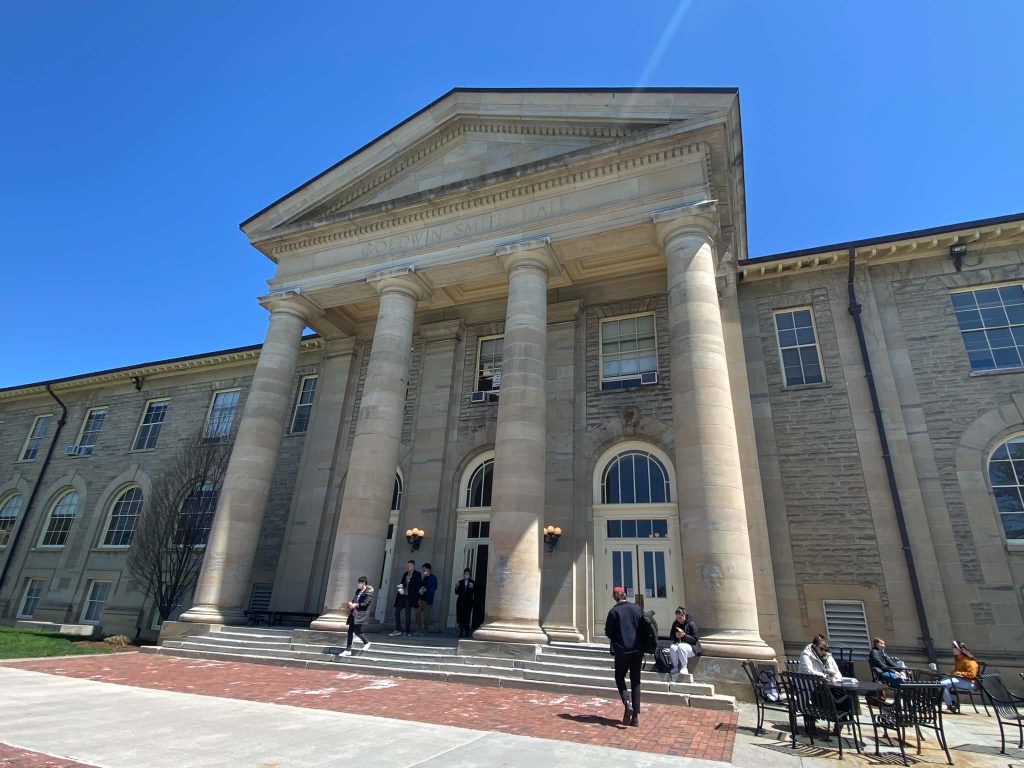
Knowing Cornell’s Past Might Help People Appreciate Its Present
Most recently I started working on a novel partly set at Cornell University. The scenes at Cornell will take place at the onset and shortly after World War II. Men were drafted into military service in 1942, even if they were in collegee. By the fall of 1946 those who served would be discharged. Many returned to finish a degree or began their college education on the GI Bill.
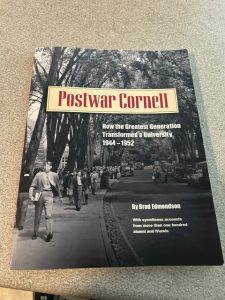
Corey Ryan Earle, a historian on Cornell’s past, referred me to a fabulous book called Postwar Cornell.
It presents interesting tidbits about Cornell in that era. I thought that parents, students and colleagues might like to read about them. Here’s a look at the cover.
Here are some interesting demographics about the Cornell community as it evolved from 1944 to 1952.
- Over 18,000 men were trained on campus for service in the army or the navy between June 1943 and September 1945.
- From 1943 to 1946, Cornell’s enrollment grew from just under 5,000 students to approximately 10,000. Today, Cornell has over 27,000.
- In 1943-44 Cornell’s civilian undergraduate student body was female majority.. At that time,Cornell and Penn were the only co-ed institutions among the Ivy League schools.
- Two-thirds of the student body that arrived in the fall of 1946 were military veterans. Today military veterans represent less than one percent of the Cornell student body.
- Jewish students represented over 1,200 members of the campus community, and over 10% of the student body. Today, Cornell has 2,500 Jewish undergrads alone, according to Hillel.org. They represent about a fifth of the undergraduate student body.
Women were treated differently at Cornell.
- Cornell had a Women’s Self Government Association (Bryn Mawr has a similar governing body today).
- Women faced strict evening curfews, a mandatory dress code, and retrictions as to where they could come and go. Curfews would not be abolished until 1968.
- First-year women were assigned to single rooms in university dorms. Clara Dickson Hall, an all-female, 420 bed dorm, then the largest among Ivy league schools, opened in 1946.
- Over half of the women who arrived at Cornell in 1946 were enrolled in the School of Home Economics; today it’s called the School of Human Ecology.
- Women enrolled in Home Economics were required to care for orphan babies in “practice apartments.” Eight women and an advisor would care for the baby over an academic year with the hope that the baby would be adopted.
Here’s some interesting highlights about the postwar Cornell community .
- As a result of Cornell’s growth, there were severe housing shortages on campus and around Ithaca.
- A temporary housing community, Vetsburg, sprung up to accommodate returning servicemen and their spouses.
- Fraternities were segregated by faith. and maintained restrictive covenants.
- Male students who opposed discrimination in the fraternity system formed a residential cooperative house called Watermargin. This cooperative house would later become coed.
- Football mattered. The Big Red lost only one game in 1948, then in 1949. They ranked 18th, then 12th in the nation.
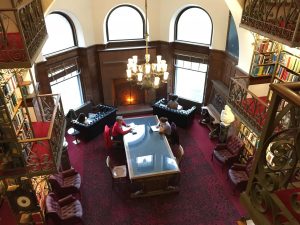
However, Cornell students who arrived after World War II were no less motivated and no less studious. They made regular visits to the libraries, just like Cornell students do today. I must thank my friend, Susana MacLean, for the campus and library photos. Postwar Cornell showed similar photos from the past.
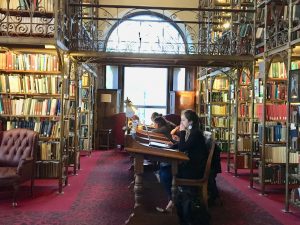
I hope this short story helps you to appreciate how campus life at a globally respected university has evolved, and that positive changes took longer than many might have hoped.
Want to know more about me?
- Learn more about my college, graduate and professional school admissions advisory services.
- Buy my book, The Good College!
- Vote to help me win a publishing contract for my novel, America’s Town!
- Listen to my latest interview on ‘Tests and the Rest’ with Amy Seeley and Mike Bergin!
- Check out my talk, What Exactly Is a Good College? hosted by test-prep experts Amy Seeley and Mike Bergin on Tests And The Rest!