Getting To Know-Cornell University (NY)
Ezra Cornell, founder of Cornell University,said that he wanted to “found an institution where any person can find instruction in any study,” . Ezra Cornell was a farmer, state senator and pioneer in data transmission in the early days of the telegraph. In this sense he was the ideal founder for such a school. Chartered in 1865, opened in 1868, Cornell could legitimately be considered a predecessor to many large public and private research universities As of last fall Cornell had just over 16,000 undergrads. Only five years earlier it had 14,700.
Cornell University offers 80 majors and over 100 minors in eight undergraduate schools.
Three of these schools: the School of Industrial & Labor Relations, the College of Agriculture & Life Sciences and the College of Human Ecology are “contract colleges.” They have agreements to provide research and assistance in service to the State of New York. The Charles H. Dyson School of Applied Economics, aka the undergraduate business school, is also a contract school through its relationship with the College of Agriculture & Life Sciences. New York residents who attend these contract schools receive discounted tuition.
One of the information sessions I attended was for Cornell’s newest school, the Jeb E. Brooks School of Public Policy.
The Brooks School opened in Fall 2021 a year after the Great Pandemic. Brooks students apply economic and statistical analysis to solve problems in Public Policy or Health Policy. Those interested in Brooks can apply to begin their freshman year in Ithaca or in Washington DC. I’m aware of many schools that have programs, even housing, in Washington DC. But this is the first time I learned of one that offers their students to work and study there during their freshman year.
Prospective students might need to compare majors within schools before they apply.
Because of the mix of schools, some relatively unique, there are Cornell majors and the career support programs that are quite tough to find at other schools. There’s also majors that seem similar but are based in different schools. For example:
- Cornell offers a BA in Computer Science through the College of Arts & Sciences and a BS through the David Duffield College of Engineering. There’s also a BA and BS in Information Sciences through these two schools as well as a BS in Information Sciences through the College of Agriculture & Life Sciences.
- Three schools: Agriculture & Life Sciences, Arts & Sciences, and the College of Engineering offer programs in Earth & Climate Science.
Cornell is a not a school where one shops for the easiest school to gain admission to your major.
Every applicant must choose a school. Each school has its own supplemental essay and admissions requirements as well as their own admissions team. Admissions are test mandatory. Based on the information sessions I attended I believe that admissions officers are well trained as to what to look for when determining who is the right fit for their school and its offerings. The College of Arts & Sciences, College of Agriculture & Life Sciences and the College of Engineering allow students to apply exploratory; they don’t need commit to a major at the start. However, Cornell does require incoming students to remain in the college that admitted them for their full freshman year.
It’s tough to get into Cornell, but those who do and commit are likely to finish.
Overall, Cornell’s most recent acceptance rate was 9%. Only a third of the Fall 2025 freshman class was filled through Early Decision; at Penn, for instance, it was just over half. Just over 60% of admitted students decided to come. That’s high for a school of this size.
Those who can get into Cornell tend to stay. Freshman retention has been no less than 96% since 2002. At least 85% of every class that has entered since 2011 has graduated in four years. Only a third of 2025 graduates had to take out loans. On average those who borrowed owed just under $26,000. The maximum that they could have borrowed through the Federal Student Loan Program was $27,000.
I had planned my visit well in advance of the news about the Jane Doe sexual assault case.
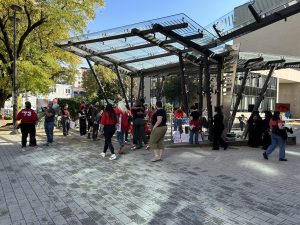
I have followed the news though I do not believe that the case will deter Cornell from filling a class with the students it usually attracts. However, I will refer readers to Hanna Stotland, a well-respected advisor who has worked with survivors and accused parties on Title IX matters. She has followed this case quite fairly and thoughtfully in the media. Hanna will help readers to understand Title IX as well as the issues surrounding this case. When I walked through Ithaca Commons the next day I saw support in the community for Jane Doe. I dropped a photo below.
.
I’ve noticed that Cornell has geographic and demographic characteristics to be considered.
- A relatively isolated location. My route from Central New Jersey was a 40-minute drive off an interstate highway to get to Ithaca and the campus.
- While Cornell houses nearly all of a freshman class, approximately 45% of the undergraduates live off campus. The university has a two-year residency requirement; that includes living in fraternity or sorority houses.
- A high percentage of Cornell students are engaged in Greek life. About a quarter of the men are members of fraternities; about a fifth of the women are in sororities. Among the Ivy League schools, only Dartmouth has a greater percentage of men and women more engaged in Greek social life.
- Cornell has suspended fraternity parties and social events for the remainder of the current academic year. But this leaves me with questions. If Cornell was to ban fraternities, how would it adjust its housing accommodations, policies and practices? If Cornell was to refuse to recognize fraternities as student organizations, could fraternities relocate and operate off campus?
- A “ruthless club culture.” This was highlighted in Cornell’s Future of the American University report and reported by the Cornell Sun, the campus newspaper. Acceptance into career-related clubs is exceptionally competitive. This is not unique to Cornell, but it is a factor that influences student life. To me it makes little sense to exclude students from academic and intellectual challenges outside of the classroom. Parents should ask admissions officers about this, especially when a similar major is offered at more than one of Cornell’s undergraduate schools.
- Cornell plays 37 D-1 varsity sports, more than any school in New York State. Within the Ivy league only Harvard and Yale play more The men’s and women’s ice hockey programs are among the nation’s best as is the men’s lacrosse program. More relevant, varsity athletes make up a fairly large (9%) of a fairly large undergraduate student body.
Looking at these geographic and demographic factors as well as the academic options, Cornell is a smaller version of larger universities in a college town setting such as Penn State-University Park or Virginia Tech. This is not meant to be an insult to Cornell, which has stayed true to the ideals of its founder while evolving into a world-class research university. But it does show how different Cornell is vs. other private and ultra-selective research universities that are more more accessible to cities and less dependent on Greek life than Cornell.
Combining these points, I had to think about who succeeds at Cornell.
The university attracts an exceptionally bright student body. Yet it does not offer easy access to a major city. I felt that much of the social life would be campus-based or focused around outdoor recreation. Unless someone was interested in an academic program that’s unique to Cornell and few other schools, the setting and social life need to be given serious consideration. Cornell can attract virtually any entertainer or speaker to campus. Barton Hall, as one example, shown below, was the the venue for one of the most famous Grateful Dead concerts nearly 50 years ago.
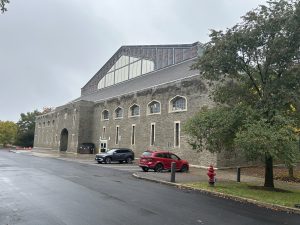
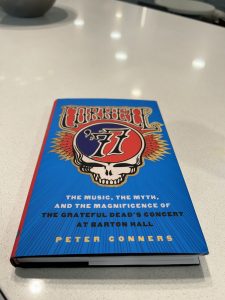
Cornell has one of the most beautiful campus settings anywhere.
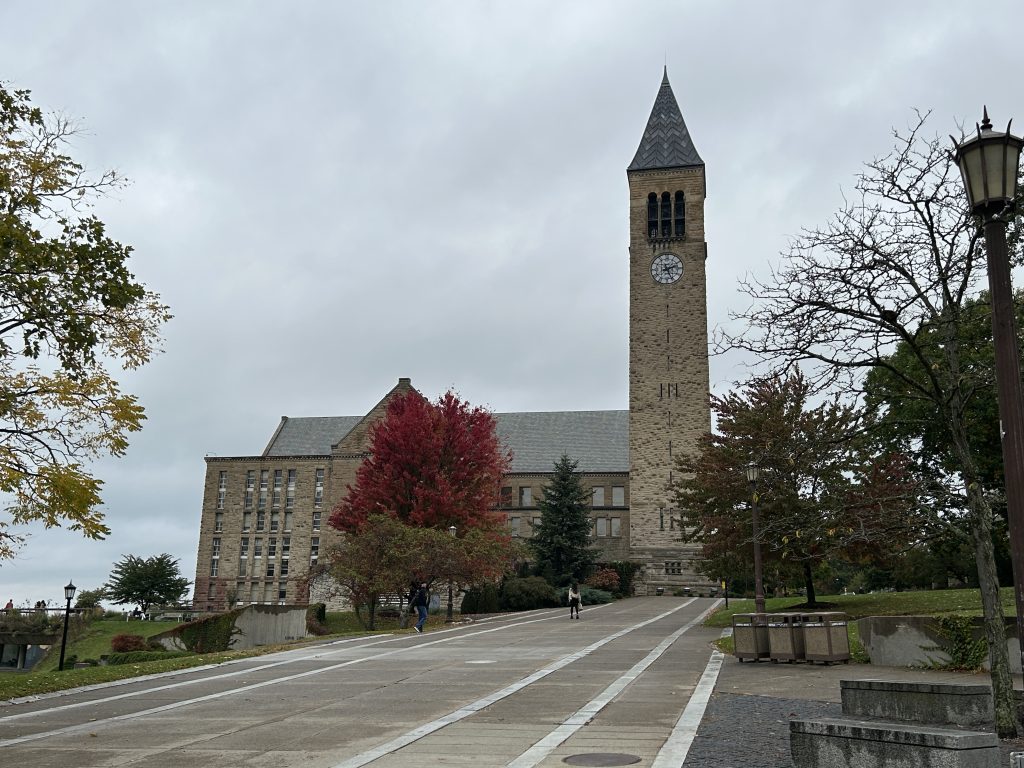
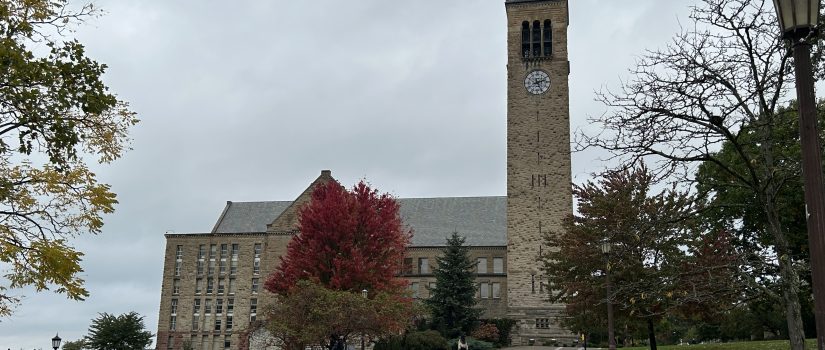
Check out these photos below. The first four, and the one up top, feature some of the buildings that people associate with Cornell. The bottom two are about the setting. To me this really sells Cornell.
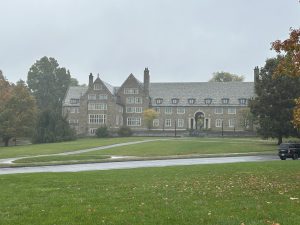
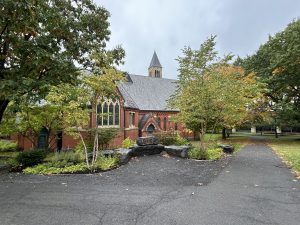
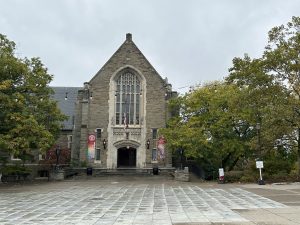



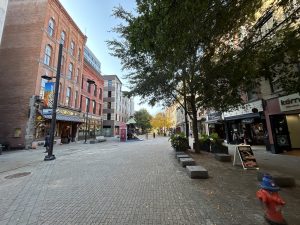
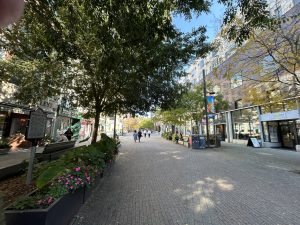
Cornell is a hilly place, and it’s not a quick walk into a downtown college town, While it was easy to appreciate the scenic beauty of the campus, lakes and waterfalls, I’ve seen nicer college downtowns than I saw in Ithaca. However, I realize time of day might have something to do with this. I was there at lunchtime on a weekday, not a Friday evening or weekend.
Conclusions
Cornell University has incredible academics and one of the most beautiful campus settings one will find anywhere. However, its’ location and demographics are different from most other ultra-selective institutions. There might be no better example of a school that one should really research and visit before they apply or commit.