Getting To Know: Ithaca College (NY)
After spending a day at Cornell Univerrsity, I took a visit the next day to Ithaca College. It’s on the other side of Cayuga Lake from Cornell and has its own special charms.
When I last visited Ithaca nine years ago, Ithaca had just over 6,200 undergraduates. Today it has just under 4,000. The largest number, approximately 1,200 are in the Park School of Communications. The next largest group, about 1,000, are studying Humanities and Sciences. Approximately 60% of the undergraduate student body comes from outside New York State. However, while enrollment has gotten smaller, interest in Ithaca has trended slightly upward since 2023. That fall just over 12,000 students applied. Two years later 14,400 did.
Although Ithaca was founded in 1892, a campus visit will leave you wondering if the college was founded 80 years later.
The original music conservatory building, located in downtown Ithaca, was sold in 1972 as the current college campus expanded up Ithaca’s South Hill. The current campus fronts Cayuga Lake on the opposite side of Cornell.
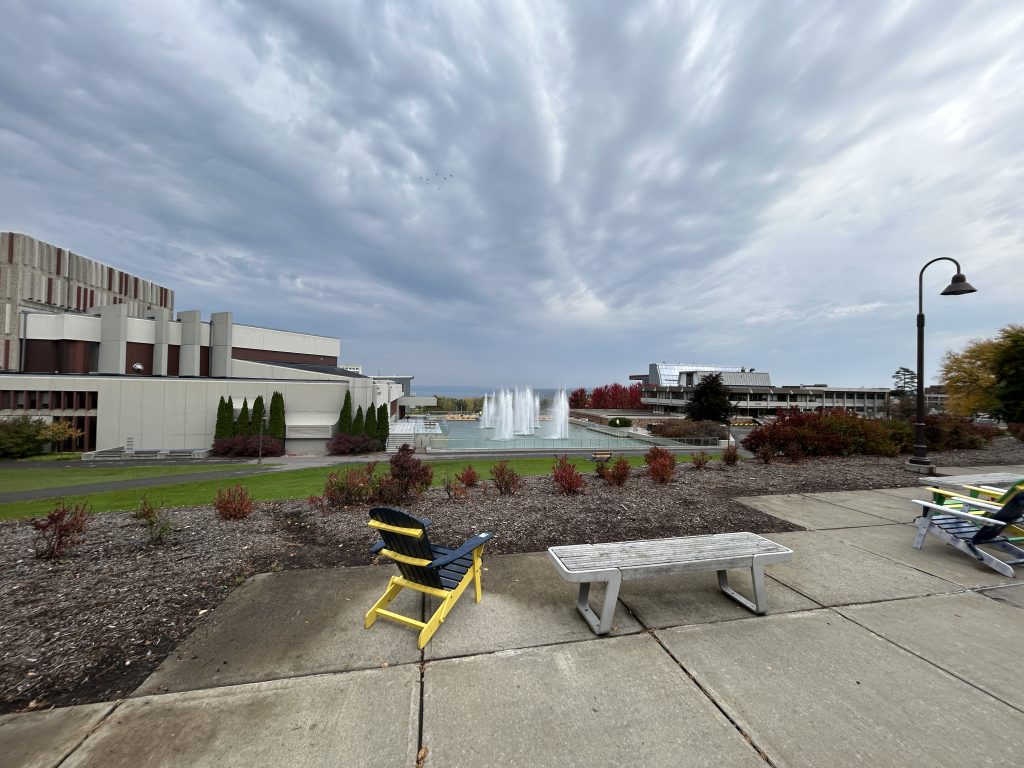
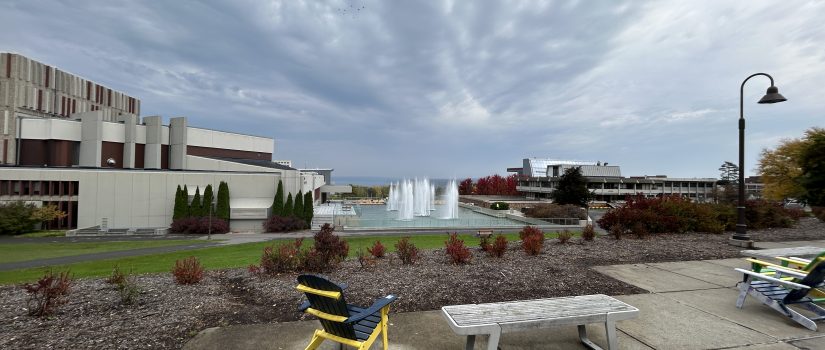
While the older buildings, including some freshman residence halls, have no outstanding highlights, each school has its own building with state-of-the-art equipment for its academic programs. It’s also rare to find a school that uses public art, water and light to make its campus into a more inviting and attractive community during warmer months. The campus is open; there is no security gate at the front. But it is also relatively easy to secure, with few streets to patrol.
Ithaca College’s roots date back to 1892 when it was founded as a music conservatory.
Today the college is divided into five schools: Business, Health Sciences and Human Performance, Humanities and Science, Music and the Roy H. Park School of Communications. Shortly after I left campus, I learned that there is a proposal to reduce this to three. The science and health professions programs would be combined into one school, business and communications into another and education, humanities, social sciences and the performing arts into another. I’m not sure what this restructuring will actually do, aside from possibly reducing some administrative costs. Maybe new courses that cross new disciplines, for one idea, marketing and analytics and social media, might happen. It’s too early in discussion to tell.
Ithaca’s history has led to the development of some very strong academic programs.
This school has more than 70 majors and more than 70 minors. The Communications and Human Performance programs as well as Music and Theatre are quite up to date . So is teacher education. Ithaca offers paths into advanced degrees in Accounting, Athletic Training, Physical Therapy as well as Teach in Five to teach at the elementary, middle school and secondary school levels in New York State. There are also paths to masters and doctoral programs in Occupational Therapy.
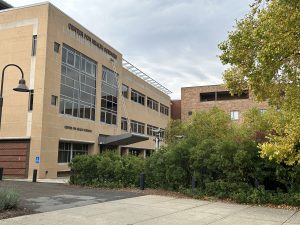
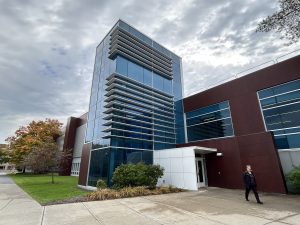
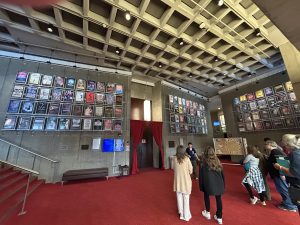
Most majors are also available as minors, opening opportunities for artists and liberal arts majors to add skill-based courses that are harder to get into at larger schools. The communications, teacher education, health professions and theatre programs have impressive facilities and have stayed up to date, even as enrollment has declined. This was the most impressive aspect of my campus tour. I dropped some photos up top and below.

Because of its academic strengths, Ithaca is cross-shopped against a variety of schools.
This school is considered more often against larger private schools such as Syracuse University as well as the home state universities where applicants reside. It also matches up well vs. Marist University (NY) in terms of academic options. However Marist is much closer to the Big Apple and has 800 more undergraduates. Ithaca College is also listed among Jeff Selingo’s 75 Dream Schools. It’s also been listed as the top school for undergraduate teaching and innovation by US News and regained for being LGBTQ friendly.
Ithaca is test-optional, though not an exceptionally selective school
Just under 70% of the students who applied to join the 2025 freshman class were accepted. Just over 1,000 enrolled. Ithaca has been test optional since 2012. Among those who submitted SAT scores, about two thirds were between 1200 and 1400. Early Decision is available but unimportant towards filling a class. Less than 100 members of the Class of 2029 arrived through Early Decision.
Among students who entered in 2024, 81% returned for their sophomore year,, low for a private college that attracts very good and talented students. The more recently recorded four-year graduation rate was 67 percent. That’s good for a school of this size that has many specialized degree programs, but could be better..
Ithaca is expensive but tries to help with costs.
For this year the estimated total cost of attendance is just over $83,000. This estimate goes down by about $4,300 for families that can present proof of health insurance.
According to the college’s most recent Common Data Set, Ithaca met, on average, 89% of need for its undergraduate student body. The average need-based scholarship was approximately $29,000. Merit awards were, on average, approximately $28,000. Over 30% of the undergraduate student body received merit awards. and just over-two-thirds received need-based awards. One thing I learned from this visit: the college will provide a four-year forecast for financial aid.
About two-thirds of 2025 graduates took out student loans to cover educational costs. The average indebtedness for those who borrowed was just under $32,000. However, this average is impacted by students who graduated from programs where they earned the bachelors and an advanced degree as well as those who needed to take out private loans. A fifth of the class borrowed from private lenders to cover the costs of their degree.
College life at Ithaca is very campus focused.
There’s a three-year residency requirement. I had to wonder, given the decline in enrollment, if this is necessary to keep the residence halls and apartments occupied during the school year. The school has a bed for everyone in every class who needs one. As a result, Ithaca houses 85% of its undergrads.First-year students are assigned to either a theme-based living program, living-learning community or a residential learning community Given that a choice of community is required, accepted students should look at the list of available communities to identify those where they believe they might be a fit.
However, the housing situation is a good thing. Ithaca has no Greek life and off-campus housing is quite expensive given that the school shares a fairly isolated college town with Cornell, a university where 45% of the undergrads move off campus after their sophomore year. The college allows freshmen to have cars, but charges them a higher fee to park on campus. Unlike Cornell, I did not see parking to be a major problem on this campus.
Ithaca competes in 25 NCAA Division III (non-scholarship) sports, including football, crew and sculling (for women).
That’s more competitive sports than you would find at much larger schools, including Syracuse, which offers scholarships in only 16. Ithaca has won 15 team national championships in eight sports. However, the women’s crew and softball programs are the only ones that have won championships since 2000. Ithaca competes in the Liberty League is all sports excluding football, where it competes in the Eastern College Athletic Association (ECAC). The football Bombers have won three D-III National Championships and have one of the highest winning percentages (.669) in D-III. The Bombers’ annual rival is SUNY Cortland. The annual Cortaca Jug Game is one of the best attended college football games at the D-III Level. The upcoming game will be played at Yankee Stadium.
Conclusions
Ithaca is a very good mid-sized college, but also a very expensive one, especially for those interested in studies that do not have an early payoff in terms of earnings after college. It helps to enjoy the outdoors because Ithaca, the community, is quite isolated,at least an hour from any city, and offers many opportunities for recreation If you like the landscape and you can cover the costs, Ithaca College is worth a look.
Report Card: Ithaca College
- Four-Year/Six-Year Graduation Rates: B/B
- Freshman Retention: B
- Costs: B
- Curriculum: A
- Community: B+
- Comforts: B+
- Connections: B+ (A for New York City and New York State)