Getting To Know: Texas Christian University
Few states go big like Texas when it comes to public universities. But Texas Christian University (TCU) might be an attractive alternative for someone who want to pursue a major they are more likely to find at a very large school, buts prefer a smaller, less intimidating setting. In addition, TCU welcomes students of all faiths, though Christian is part of the university’s name and branding. Yes, a religion course will be required. However, coursework in Christianity is not.
I gathered a few photos on Pinterest to show that to you, since I could only take only virtual visits. However, I’ve got a few updates since I wrote my first story about TCU during the pandemic. I also watched an episode of The College Tour that offers insights into this school. The university also posted a shorter tour.
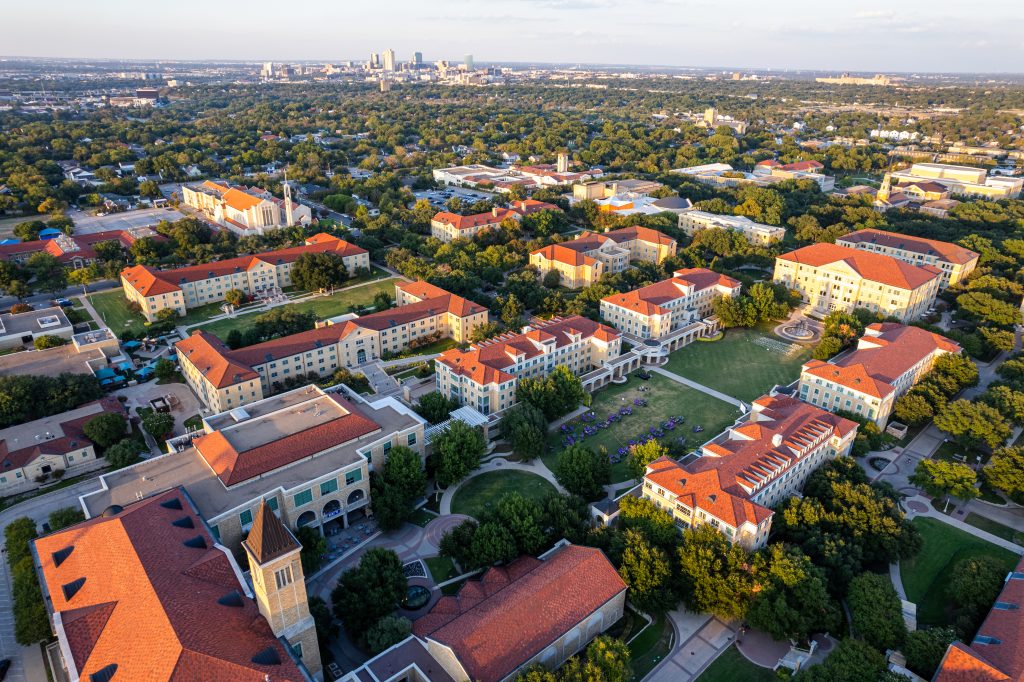
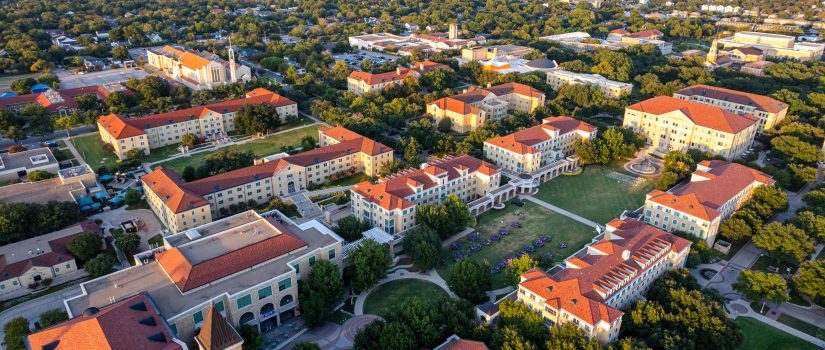
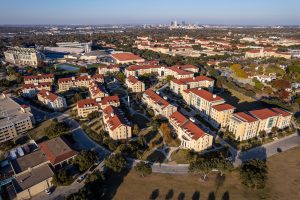
TCU moved to its current location in Fort Worth in 1910. But this campus looks like it was founded more recently. I must thank Lily Green, TCU’s Assistant Director of Admission Marketing and Communication for providing photos for me to share. While I was only a virtual tourist, I really like the look and feel of this campus as it tries to blend its earliest and most modern buildings. Below are photos of the Neeley School of Business, the Honors College and Greek Village. An aerial view of the campus commons is up top.
With this story comes a special treat: Olivia Christiansen, TCU ’25, who recruits out my way, agreed to do a Zoom interview and tell you more about this school. I hope that you’ll listen and hear about TCU from an alumni and admissions perspective!
I did some research to prepare for my meeting with Olivia. TCU has seen steady growth in interest since the pandemic. In 2021, TCU attracted just under 20,000 applicants, accepting fewer than half to get a class of just under 2,600 freshmen. There were nearly 23,000 applications in 2025, again less than half got in, for a class of just under 2,800. As of the 2025-26 academic year TCU had just over 11,000 undergrads; ten years earlier there were fewer than 9,000. TCU also has very ambitious campus expansion plans with a goal towards 15,000 undergrads by 2033,
I understand some of the appeal, especially within Texas, which has flagship state universities with exceptionally large undergraduate student bodies, larger than the state schools where I am on the East Coast. At present, Texas residents about half of the undergraduate student body. California has the second-largest representation from within the US followed by Illinois and Colorado.
TCU has more majors than many large public universities based in nine undergraduate schools.
It’s possible to enter TCU undecided on a major in a “pre-major” status and not choose a specific school. However, it’s helpful to work with academic advisors to know the internal transfer requirements for the schools that will be home to one of the possible majors.
Nursing is one of the more popular majors, welcoming 200 freshmen each year. It’s actually possible to apply into this program after freshman year; the same is true for business. Those who enter nursing after the freshman year would likely need an additional semester or two to graduate in order to complete courses and clinicals. Business students may apply for internal transfer after the freshman year, provided that they have a 3.25 GPA at minimum. Finance, Marketing, Accounting and Real Estate are among TCU’s most popular majors.
You’re not likely to see as many large-lecture classes as you might see at UT-Austin or Texas A&M. Only 6% of classes at TCU taught in 2023-24 had over 50 students.
TCU students can even gain an advantage in medical school admissions, if they do well here. The university partnered with the University of North Texas to open the Burnett School of Medicine in July, 2019. While the school welcomes only 60 candidates each year, TCU alumni are well represented in a cohort.
The students who choose TCU also stick around.
Freshman retention has been 90% or better since 2015; the high is 93% for the class that arrived last year. TCU has graduated 70% of the freshmen who have arrived in every entering class since 2015.
TCU has a more residential community than you would find at a public university in Texas or the neighboring states.
Nearly half of the student body lives on campus, and more private housing is planned to open nearby. Greek life is relatively popular at TCU, attracting over 40% of the men and more than half of the women. It’s easy to see why after watching YouTubes. The Greek Village first opened in August 2017.Like most other schools, students could probably live without Greek life. But the campus is about a half hour by bike from downtown Fort Worth. Buses are available, to get around. But TCU appears to be a place where access to a car is quite helpful. Parking downtown is free.
Fort Worth is America’s 10th largest city.
I had always thought of Dallas-Fort Worth-Arlington as one metro area, especially after hearing it described as the ‘Metroplex’. However, Fort Worth is a city with around 875,000 people, more than San Francisco, Seattle or Denver. American Airlines is headquartered in Fort Worth. So are Pier One Imports and RadioShack. Bank of America, Wells Fargo and Lockheed Martin also have a significant presence in the city.
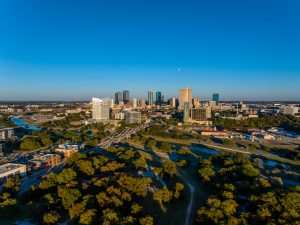
Known as the “City of Cowboys and Culture,” Fort Worth has a large arts community, including an impressive Cultural District. While I don’t know the transportation network of the city, it is definitely possible for students to find more than enough to do off campus and secure internships and jobs. I found that approximately half of the alumni registered in LinkedIn.com were still living and working in the Dallas-Ft. Worth area. I dropped a downtown photo below.
TCU is one of the smallest universities that plays in a Power 5 sports conference.
The Horned Frogs have not won a National Championship since 1938. But TCU ranks fourth among private colleges in football success behind only Notre Dame, USC, and Miami. The Horned Frogs are also one of only four teams to have played in all six College Football Playoff Bowls, winning all but the Fiesta and Orange. Best yet for TCU students, admissions to football games is free.
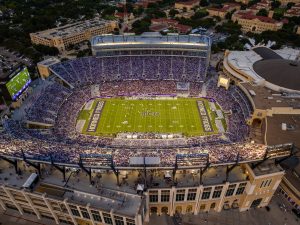
Amon Carter Stadium and the football complex are among the finest in the sport. Amon Carter has been labeled as “the Camden Yards of College Football,” a reference to environment in the Baltimore Orioles major league baseball park. After listening to a program, 100 Stadiums in 100 Days, I’d say that Amon Carter has Camden Yards beat. This stadium seats less than half the numbers you’ll find at UT-Austin, Texas A&M and the larger Big 12 and Southeastern Conference schools. But it feels no less festive inside.
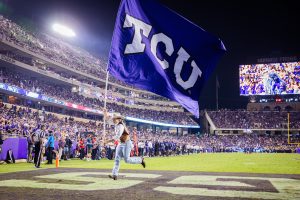
Few universities can match TCU for athletic branding and pizzaz. And football is not even this university’s most dominant NCAA sport. Riflery, baseball and women’s soccer have had more successes in their histories. In addition, I had not heard of a school offering stipends to members of a marching band, until learning about TCU.
TCU also has one of the more interesting mascots in college sports. The Horned Frog is really a lizard, though it share characters I might have associated with frogs. Student introductions to traditions are called Frog Camps. TCU is also quite involved in protecting the real species within Fort Worth. Below are different examples about how the horned frog is weaved into campus lore.
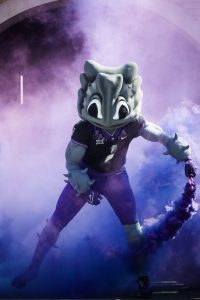
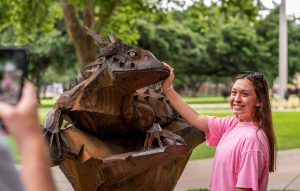
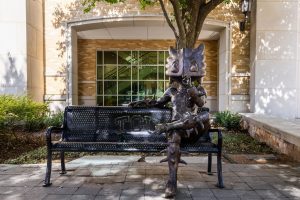
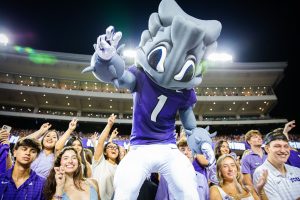
Texas Christian University is in a competitive market for students, and has become more competitive, too.
TCU has accepted less than half of the prospective freshmen who applied to from 2023 to 2025, though the classes grew from just under 2,500 to just under 2,800 freshmen. TCU remains test optional even as Texas’ major public universities, UT-Austin and Texas A&M, have become test mandatory.. The middle 50% range for students in the Class of 2029 who submitted SAT scores was between 1200 and 1380. For the ACT it was between 28 and 32.
If you like what TCU has to offer, apply early. Eighty-two percent of admits to the Class of 2028 came through Early Action or Early Decision. Acceptances rates for Early Decision and Early Action were 69% and 50% respectively.
However, this experience may be too expensive for many prospective students.
TCU’s estimated cost of attendance approaches $90,000. However, while TCU is not likely to undercut Home State U for many families, the more generous scholarships might make it more attractive than Neighboring State U. Sixty percent of the incoming freshmen in the Class of 2029 received merit awards that averaged over $23,000. Two-thirds of the Class of 2024 graduated with no student loan debt, either because of a generous scholarship,or their families had the ability to pay. But thise who fall in the middle had to take out private loans.
Conclusions
I can understand why many prospective students will like TCU. It has the vast selection of majors, sports and social activities found at a very large school but also has a student body that’s smaller than most any flagship state university. My research and my conversation with Olivia led TCU to remind me of Elon and Villanova (both outside of football) as well as Tulane and the University of Miami. TCU and these schools are seeing potential for growth at a time when other schools fear downward trends in high school enrollments. However, also like these schools, the costs will need to work out for the cost conscious.
Listen to my interview with Olivia Christiansen now!
Report Card: Texas Christian University
- Four-Year/Six-Year Graduation Rates: A/A
- Freshman Retention: A
- Costs: B
- Curriculum: A
- Community: A
- Comforts: A
- Connections: A (Texas)/B+ (California)/B (elsewhere)
Learn more about me!
- Learn more about mycollege, graduate and professional school admissions advisory services.
- Vote to help me win a publishing contract for my novel, America’s Town!
- Buy my college advice book, The Good College!
- Listen to my latest interview on ‘Tests and the Rest’ with Amy Seeley and Mike Bergin!