Getting To Know: University of Austin (UATX)
I came to learn about the University of Austin (UTAX) from a student who attended a summer fellows program, I learned enough to make me want to learn more about the university. This is also the newest private college in our country.
The University of Austin is also being labeled “the anti-woke university” because of the political views of some donors and faculty members. Yet it is promoting itself as an institution where students are free thinkers who swant to seek and find their truth.
I can also understand why Austin is the location for such an ambitious educational venture.
It has the youth-oriented culture, business community and economic growth ro support it. One could be led to believe that Austin is the Berkeley of the Southwest. It has its liberal communities as well as a more button-down corporate culture in a state whose tax structure is more favorable to starting businesses. It would be wise to check out Austin’s downtown vibe, especially since the campus is downtown.
UATX reached out to people of various experiences and viewpoints to become faculty and advisors.
I knew of two advisors, Caitlin Flanigan and Andrew Young, who are associated with left-leaning views. Some, like historian and Hoover Institution Fellow Niall Ferguson (photo below) are associated with conservative viewpoints.

I looked at the faculty roster.
I recognized one faculty member, Michael Shellenberger, who penned San Fransicko, a book about the causes of homelessness in San Francisco that’s been accepted in conservative circles. Another faculty member, Kirsten Herlin, does a Great Books podcast with the National Review and has written pieces for the Weekly Standard. However, I also find it fascinating to see that one faculty member, Eliah Overbay, brings expertise in bioastronautics that’s tough to find anywhere.
I reached out to Dr. Loren Rotner, Associate Provost for Academic Affairs and Executive Director of Admissions at the university.
Dr. Rotner came to UATX from St. John’s College (MD and NM) and has also taught at the US Naval Academy. His perspective was important to helping me understand how this school was trying to educate its students. He told me that UATX follows through on the model used at the University of Chicago during the 1950s. that incorporated two years of general education courses for all students to be followed by two years of specialized work. Dr. Rotner graciously agreed to a Zoom interview–and I invite readers to listen now.
Here are aspects of other models that some will recognize.
Great Books Curriculum
Unlike St. John’s College, the most notable Great Books curriculum school, UATX students receive grades, with narrative evaluations available upon request. At. St. John’s it’s the opposite; narrative evaluations come first; grades are available upon request to help students and alumni find jobs and gain admission to advanced degree programs.
Project Based Coursework
Hampshire College, which recently closed, took the project-based education to extremes that were successful. However, it had access to the resources available at four other colleges, including three well-endowed liberal arts schools and a flagship state university. Worcester Polytechnic Institute (MA) is also quite project based over four years.
UATX has access to sponsors outside of the university, and outside of higher education, who can help students with laboratory space, advanced technology, advisors and mentors. But I don’t know how lines will be drawn or blurred when a Polarus Project evolves in a corporate lab versus a college lab.
I also want to thank the UATX communications team for providing me with photos.
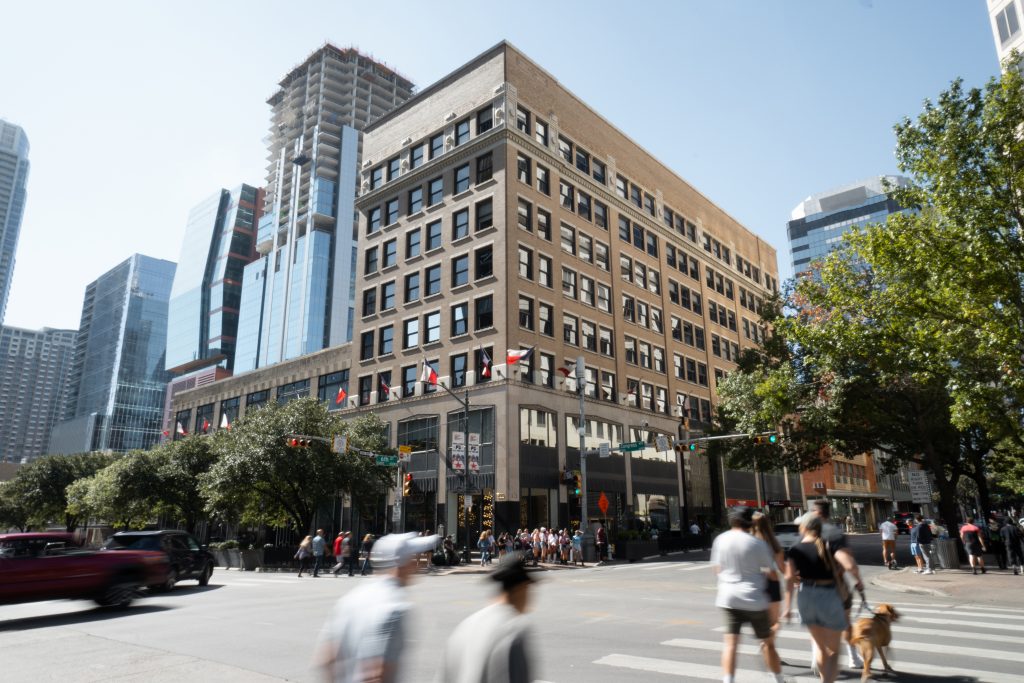
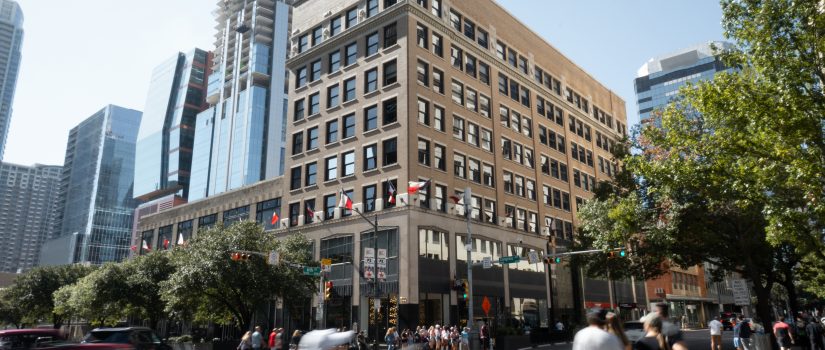
The photo below shows the Dean’s Honors Dinner which uses the university’s atrium space and a guest lecture by Scott Malikin, founder of Value Retail Plc, which used another gathering space. The current campus is an adaptive reuse of the former Scarborough Department Store near the state capital building. That’s the photo up top.


UATX may borrow from proven educational models but the structure is different.
A UATX education is a blend of Great Books (St. John’s College), concepts in modern technology and leadership (military service academics), projects (Worcester Polytechnic Institute) and independent mentored research (Princeton and The College of Wooster). There’s serious rigor here. A total of 155 credits, five courses per quarter, is required for a degree.
All students earn a degree in Liberal Studies. They must complete a core curriculum but also have choice of concentrations, including:
- Literature and Creative Writing
- Ethics and Politics
- Economics, Politics, and History
- Computing and Data Science
Administrators envision this school to have a start-up culture, much like enterprises in Austin.
A Polaris Project, a start-up proposal unto itself, is required to earn a degree. Students use the first two years to consider what their project might be, possibly experiment within the classroom and outside through study abroad or away or at internships. The last two years are devoted more towards refinement and execution.
My impression is that the more immediate success of this school will be dependent on the quality of work that stems from the Polaris Projects. Given the level of investment in the institution as well as the original students, investors will likely expect a high return. That return might not necessarily be financial, but it can be in the intellectual strengths of the graduates. Will these students come up with innovations in business, technology and public policy? Will they be a next generation of thought leaders? We will need to wait until a senior class has presented completed projects.
Shy people might not like this school.
Classroom conduct in small seminar courses is moderated by the faculty to encourage different viewpoints to come out without repercussions. The phrase used by faculty is Chatham House Rules. It reminded me of a phrase I read about in sports locker rooms: What you see here, what you hear here, let it stay here when you leave here.
Students talk, and try to persuade classmates towards their views, but they do not conduct the class. A lot of reading is expected across quarterly courses, possibly more than required at many semester calendar schools.
The University of Austin has welcomed three classes, now recruiting for a fourth.
The three previous classes have approximately 250 students working towards their degrees. The university is on schedule to be accredited by the Middle States Commission on Education in March, 2028. That’s just before their first class will graduate. Most interesting, the education is tuition-free with a potential to receive an additional $10,000/year in merit aid to go towards housing. The leadership of the university has raised over $300 million to advance its educational model and objectives, with a long-term commitment to remaining tuition free.
Test scores are the primary indicator of merit..
The university will consider applicants with lower scores but they must be supported by high AP/IB scores. This is a response to grade inflation in high schools. Dr. Rotber told me that applicants self select this school. This is, in part, due to the demanding academics. This is not a school where you can love politics and literature but avoid science and technology or vice versa.
The website has minimum scores tied to automatic admission:
- 1460 or higher on the SAT or
- 33 or higher on the ACT or
- 105 or higher on the Classical Learning Test.
Conclusions
Given the newness of this school, it’s impossible to give it a Report Card as I have done with more established institutions. I have seen other schools model curricula on classical education, leadership development, basic STEM principles and experiential learning, but not all four together in an independent (non-religious) environment.
UATX is a controversial, but interesting institution. One thing it has shown: proven educational models of the past can work in the present when the resources are there to execute them properly.
Listen to my interview with Dr. Loren Rotner now!
Learn more about me!