Getting To Know: Yale University
One of my favorite college admissions videos is TThat’s Why I Chose Yale. The original video was even spoofed. which could be a complement as much as teasing. I sat in the admissions information session room at Yale and, although we did not get an information session, I could not help but hear the song in my head. I even teased our tour guide to ask if she and her guide in training would sing it.
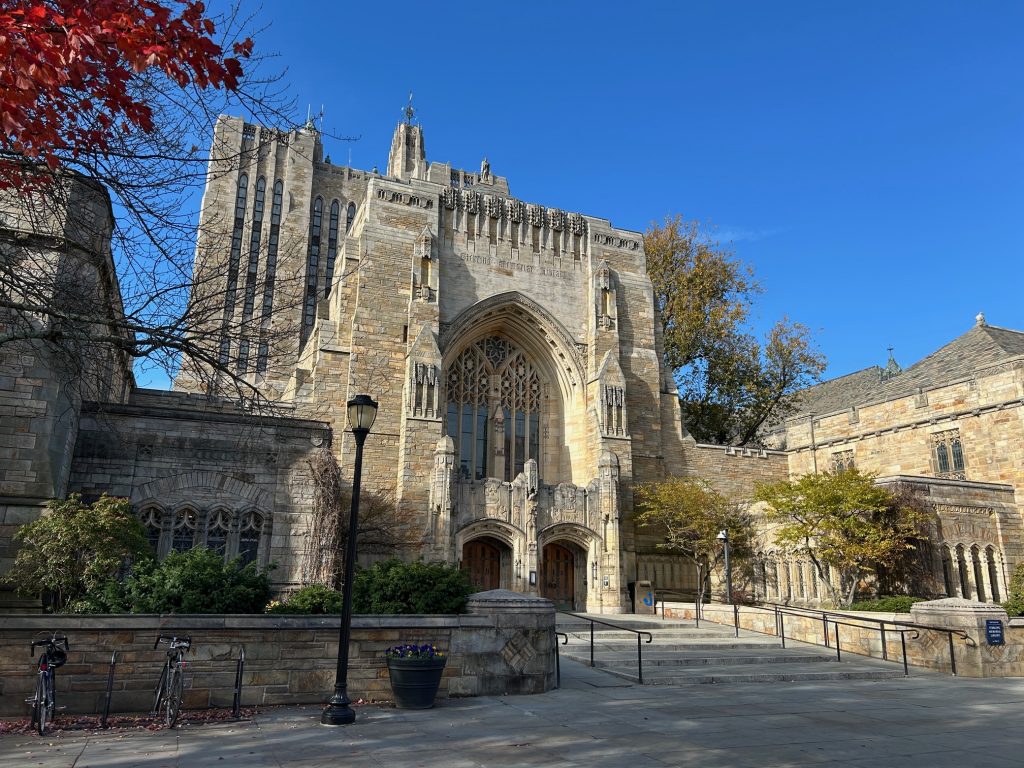
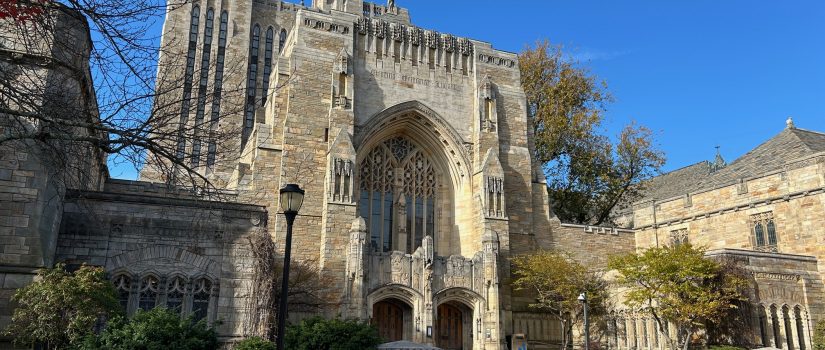
Yale also has earned its place in dark academia through Leigh Bardugo’s novels, Ninth House and Hell Bent. Bardugo is also a Yale alum. This is a campus where one can walk around and imagine who came here before them and made the history they made. I’ve dropped some photos below. There’s no dominant architectural theme on this campus, but everything just seems to blend so well that it doesn’t matter.
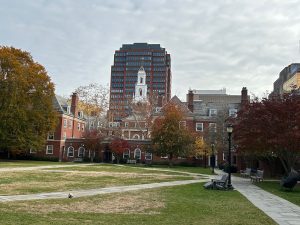
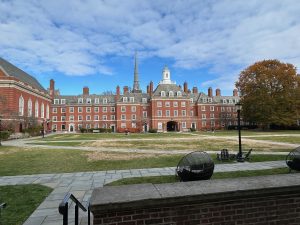
Yale has the look and feel of a liberal arts college pumped up to a university level.
Undergraduate campus life is focused on distribution requirements and a 14 college residential college system. The university’s distribution requirements are quite similar to many selective liberal arts schools; students essentially take two courses in each academic area. They can double dip distribution requirements to start a second major or work towards certificates. However, it’s not possible to complete formal minors.
When an exceptionally selective school like Yale has requirements like these, it is reasonable to expect incoming freshmen to have attained success in every academic subject they’ve pursued in high school. Yale can accommodate students who do not “love” a particular subject. But that does not mean that the university wants students who have serious weaknesses in those subjects. Given that Yale is essentially Yale College vs. a school of arts & sciences and a school of engineering, students do not apply to a specific academic program. The institution is a “single doorway,” where one can explore subjects before deciding on a major.
Yale students are randomly assigned to residential colleges; only four of 14 house first-year students. Like students at other schools, Yale undergrads do move off campus, but maintain affiliations with the residential college for dining and recreation, among other things. However, partly as a result of the residential college system, three-quarters of Yale undergrads live on campus.
I left campus thinking that Yale was more undergraduate focused than other Ivies.
However, When I got home I checked out the data and was wrong.
- Yale College, the undergraduate school, has approximately 6,700 students. However, there are also over 8,800 graduate and professional school students.
- Princeton, by comparison, has 5,800 undergraduates but fewer, only 3,300 graduate students.
- Dartmouth’s total enrollment, undergraduate and graduate students, is about the same size as Yale’s undergraduate student body.
- Brown has about 300 more undergrads than Yale, but 200 fewer graduate students than Princeton.
Yale has a student-faculty ratio of 5 to 1, lower than most smaller liberal arts colleges. Only nine percent of all undergraduate classes taught at Yale have more than 50 students. Seventy-three percent have fewer than 20. For comparison’s sake the student-faculty ratio at Princeton is also 5 to 1. Seventy-six percent of their undergraduate classes have fewer than 20 students while 10% have more than 50. However, Princeton, an undergraduate-majority school, has a smaller undergraduate student body.
This does not mean that Yale undergrads do not do research with faculty. They do. But Yale is also “big business” when it comes to being a research university. If you’re seeking a school where undergraduates get more of the attention from the faculty, well-endowed liberal arts colleges might offer more direct access to faculty for research and references.
The toughest aspect of Yale is getting in.
Acceptance rates have been below five percent for the past four cycles. Interestingly, there were fewer over 7,000 fewer applicants for the Class of 2029 than there were for the class that entered the year before. Among those fortune to be admitted over two thirds decide to enroll. Also interesting, the size of Yale’s freshman classes has grown from fewer than 1,400 in 2016 to over 1,600 today.
Yale calls itself test flexible.
Applicants can submit AP or IB scores as well as SAT orACT scores. This policy might advantage a student who has loaded up on AP or IB courses before the start of their senior year, but disadvantages students who come from less-resourced institutions. During the 2023-24 admissions cycle 61 percent of admits submitted SAT scores, the middle 50 percent ranging from 1480 to 1560. Needless to say, Yale draws plenty of students who present academic records with plenty of rigor and no weak spots
.Yale uses Single Choice Early Action versus Early Decision.
While this admissions policy is non-binding, it restricts your ability to apply Early Action to other private institutions in the US unless they make those admissions decisions after January 1st–after Yale makes its own decision in mid-December.
Unlike many schools that get the majority of a freshman class through Early Decision, Yale does not get the majority of its class via Single Choice Early Action. For the last cycle, 31% of the class was admitted via this route. The admit rate for those who applied under Single Choice Early Action was just under 11%. Still, the odds were more in an applicant’s favor under this policy. The acceptance rate for those who applied Regular Decision was less then four percent.
Applicants who get deferred or denied under Single Choice Early Action should have enough time to apply Early Decision II to another school that offers that opportunity. But that school will not be another Ivy. Those schools do not offer an opportunity to Early Decision II. The most comparable schools to Yale that do include Emory, Johns Hopkins, the University of Chicago and Washington University in St. Louis.
Yale has grown its traditional undergraduate enrollment.
Total enrollment at Yale College jumped from 4,700 in 2020 to over 6,500 in 2021 and has grown ever since. Thosw who choose to come choose to stay. The latest Common Data Set showed a freshmen retention rate of 99%. I’m quite surprised that Yale publishes a six year graduation rate on its pages. Is this because of financial aid policies or to show that nearly everyone who entered eventually graduates? I went to Yale’s latest Common Data Set and got four-year graduation rates of 66 percent foe the Class of 2021 and 58% for the Class of 2022.
It you can get into Yale and finish, you’re likely to graduate with minimal student loan debt. Only 12 percent of 2024 graduates had any debt at all. Among those who had to borrow, the average indebtedness was less than $7,300.
Yale has more of a sports history than some might believe.
Across all NCAA D-1 athletic programs Yale ranks fifth in terms of national championships being only Stanford, UCLA, the University of Southern California and Penn State. The most famous Yale athlete might be George H.W Bush, 41st President of the United States who helped the baseball Bulldogs advance to the 1947 and 1948 College World Series.
The Bulldogs compete in 35 sports. Within New England only Harvard competes in more. Yale has played football since 1872 winning 27 national championships and two of the first three Heisman Trophy awards in the earlier days of the sport. Since the Ivy League was formally founded in 1955, Yale has won the conference championship 19 times, most recently this year, and recently won their first-ever Football Championship Series playoff game.
Yale also has the oldest intercollegiate men’s hockey program in the nation, most recently winning an NCAA title in 2013. The men’s lacrosse program won their second national title in 2018 and made it to the championship game the following season, only to lose to the University of Virginia. Three years later, the lacrosse Bulldogs were Ivy League champions. Yale also has the oldest collegiate squash program, last winning a national championship in 2016. The men’s basketball program has won seven Ivy League titles, the last coming in 2020.
New Haven, home to Yale since its founding in 1701, has its charms.
The East Rock and College Street sections of town as well as Wooster Square are quite interesting. New Haven is also about 90 minutes from New York City by train. New haven has also been cited as a desirable place for start-up businesses because of Yale’s presence in the city, lower housing and construction costs versus larger Northeastern cities, plus easy access to those cities by train and off Interstate 95.
However, New Haven is not like downtown Princeton, Providence or Cambridge where one can walk right into a college town. Yale is also not the easiest campus to park before you visit. Give yourself time to find a space; most likely one close to the Visitor’s Center where you can parallel park and get right to your tour.
Conclusions
It’s really silly for me to make a report card for Yale. The university has every resource that an exceptionally bright student could ever want as well as the history and traditions that put an Ivy League school on so many radars. I especially like the residential college system as a way to help students to succeed socially and academically.
Honestly, the only thing I don’t like about Yale is the physical appearance of New Haven as a college town versus other schools such as Princeton or Brown. But if someone told me that Yale had a more beautiful campus then Brown or Princeton I would keep quiet and let them tell me why.
Buy my new book, The Good College!
Listen to my latest interview on ‘Tests and the Rest’ with Amy Seeley and Mike Bergin!
Check out my talk, What Exactly Is a Good College? hosted by test-prep experts Amy Seeley and Mike Bergin on Tests And The Rest!