
I Learn More About Stanford From A Recent Grad
I recently finished reading How To Rule The World, An Education In Power At Stanford University. The author, Theo Baker, the son of Washington Post journalists tells an “inside story,” a memoir that only a Stanford student could write.
During his freshman year Baker entered Stanford with aspirations in technology, though he was not quite sure what they were. He joins the Stanford Daily as an extracurricular curiosity, with no intentions of becoming a journalist. I’ dropped a photo of the cover below.

How To Rule The World is partly about the campus culture, partly about a case of academic integrity and research misconduct
Baker’s reporting led to the resignation of the university’s president as well as members of his cabinet. I was impressed by how far Baker got in his investigative reporting, But I was more interested in learning about the students and campus life.
Baker reports that Stanford students are motivated by “the deal,” the potential that they can become entrepreneurs, even before they earn a degree. I saw some of this when I toured the engineering school ten years ago. I would agree with Baker that Stanford has the most entrepreneurial/tech-focused student body of any school that I have personally visited.

 Students meet From Baker’s tales venture capitalists on campus, attend yacht parties off campus. Tree Hacks, an extraordinary hackathon, is nothing like similar events at other colleges. Baker takes us into the inner workings of this event. There’s also amusing take about a squatter who managed to convince many people that he was actually a student. I also learned that while Stamford students seek the same avenues for fun as their peers at other colleges, the university administration clamped down harder on parties than most universities have done.
How To Rule The World was not the first book that I read about Stanford students.
I had previously read A Practical Education by technology writer Randall Stross In this book, written in 2017. Stross organizes A Practical Education around two themes: the pressures on Stanford to offer “practical and employable skills” to all students, regardless of their major, and the successes of alumni who chose a liberal arts major versus the more marketable majors in Computer Science and Engineering. Those successes were not immediate. Those profiled did not know what they wanted to do after they had earned their degree. Quite frankly, their stories could be the same as those of Rutgers graduates, only most of the Stanford alumni profiled in the book wanted to make their connections in Silicon Valley.–much like Baker’s classmates wanted to do in How To Rule The World.
I recommend that parents and prospective Stanford students read both books.
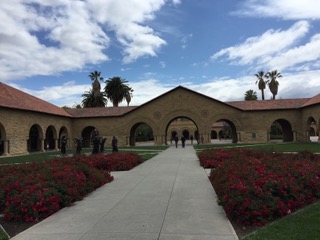
Stanford University was one of my “dream schools” growing up in Central New Jersey. It had everything that I would never find at a college close to home: year-round sunshine, major college football and a gorgeous campus, not to mention fine academics. Ten years ago, I awaited my visit to Stanford with more eagerness than past visits to other schools, with the exception of an opportunity that I had to tour the car design studios at Art Center College of Design several years before. I made a Pinterest page, but I decided to take a different tack at reporting on this visit. It’s really silly to make a Report Card for Stanford. This school goes to extremes to be affordable and accommodate career and academic interests that few others can.
Is Stanford University the “Harvard of the West”? Perhaps.
Leland Stanford, founder of the University went to Charles Eliot, then president of Harvard, for advice on how to honor his late son, Leland Jr.,who had died of typhus at the age of 15. Eliot suggested that the railroad magnate (or “Robber Baron,” if you prefer), then a U.S Senator, establish a university. Stanford did precisely that, on more than 8,000 acres of land in Palo Alto. Two of the original conditions of the charter: the university could never leave the campus grounds, and it had to charge no tuition (which it did until 1920).
Harvard, of course, has a lot more history. It predated Stanford by 255 years. It has the larger endowment ($56 billion vs. $41 billion in FY 2025). However, Stanford has closer to 8,000 undergrads. Harvard has closer to 7,000.
Stanford and Harvard have similarities:
- Both practice Restrictive Early Action in their admissions policies; students who choose of these schools as a first choice cannot apply Early Action to another private school. Stanford gets a third of a freshman class through this practice.
- Both will meet a family’s full financial need.
- Nearly every undergraduate at either school lives on campus.
- Both border on downtowns with many student-oriented businesses for dining, drinking and shopping as well as businesses that have a “tech flavor” to them.
- Both supply talent to technology corridors that are important to the growth of the U.S. economy.
- They are in immediate proximity to the venture capital community in their region.
- The schools have a similar mix of graduate programs in arts and sciences, business, education and engineering as well as professional degrees in the design professions, law and medicine.
- Virtually everyone who gets into either school returns for their sophomore year.
- Of course, both schools are exceptionally difficult to get into. Applicants have a less than five percent chance of getting into either school, even with the most stellar credentials.
- And I learned from Theo Baker than both of their own versions of secret societies.
And there are differences beyond geography and the physical appearances of the campuses.
Harvard’s roots come from the ministry, one explanation of why the university has a divinity school.
Stanford stand out in these ways
It is the more STEM-driven school.
Stanford has offered engineering throughout its entire history while Harvard added it during this century. Of course, Harvard has shared its host city with MIT since 1916. Their students were welcome in MIT classes when Harvard did not have the same class available. They still are.
It has a longer history with coeducation.
Stanford has admitted women since its founding in 1891. Harvard did not allow men and women (at Radcliffe College) to take classes together until 1943. It did not formally dissolve its women’s college until 1999.
Stanford has a very large campus in one town while Harvard is spread through three (Allston, Boston and Cambridge) in a densely-packed urban center.
If you don’t like city life, you might prefer Stanford. The closest large city to Stanford is San Jose, which actually has a larger population than Boston, though San Francisco is less than 40 miles away.
Stanford competes in scholarship varsity sports at the highest (NCAA Division I) level while Harvard grants no athletic scholarships.
Athletes are likely to be a larger part of smaller freshman classes at Stanford. In addition, Stanford’s “Big Game” is against a state university (UC-Berkeley) while Harvard’s is against a private “peer” (a perception of those who did not go to Harvard), Yale. I would probably say that Stanford has the better athletes in the sports that both schools play, mainly because it can entice them with scholarships regardless of financial need.
Stanford has Greek life. Harvard does not.
Fraternities and sororities attract almost a quarter of Stanford’s undergraduate student body.
Stanford operates on a quarter system, much like its sports rivals on the West Coast,
Harvard operates on a semester system. Stanford students take a three or four-course load. Engineering is a more brutal academic experience on a quarter system than a semester system.
Stanford has three undergraduate schools,.Harvard is only Harvard College.
Stanford offers the option to apply to an undergraduate college in ESustainability as well as degree programs in Architectural Design and Product Design. While Harvard offers engineering degrees, it is more of a liberal arts school than Stanford.
Of course the comparison means little if you get into only one of the schools, or if you miss on both of them. Those who get into only one will most likely go to that school. And if you have the chance to tour Stanford, take it. Save time to take the separate tour of the Engineering Quad, even if you have never been or never will become an engineer. This scientific heart of “Nerd Nation” will literally blow your mind!
Learn more about me!
