

Getting To Know: University of Maryland-College Park–Again
I was recently invited to a Counselor Day at the University of Maryland-College Park. I went through my files and realized that I had not been there in ten years. So, it was time to go back and do research to write an update, I also updated my Maryland Pinterest page. This school has cracked my Public Ivy lists multiple times, including 2026-27. There’s a lot to cover. So, read on!
The University of Maryland-College Park has tremendous academic breath.
There’s over 100 majors and over 90 minors based in 12 undergraduate schools. The agriculture, architecture, business, education, engineering, public policy and science programs are extremely well respected. The Phillip Merrill College of Journalism, is one of only 22 such schools based at a flagship public university. It’s also one of the more selective, accepting less than half of those who apply.
It’s quite common for students to double major or carry majors and minors in two undergraduate schools. However, Maryland’s nursing program is a divided opportunity where students begin their first two years at College Park, then their last two in downtown Baltimore.
The University of Maryland College Park handles some academics a little differently.
In addition to conventional requirements in the liberal arts and mathematics, Maryland requires two project-based courses called Scholarship in Practice. One must be outside the major. They must also take two Big Question courses focused around a problem of interest,
In addition, honors-level opportunities extend far into a freshman class. Approximately 1,000 freshmen enter College Park Honors, which has eight living-learning programs . Another 1,000 are enrolled in one of 13 College Park Scholars programs. Just over 600 are selected for First-Year Innovation and Research Experiences (FIRE and BioFire).
While these programs are selective, there are other living-learning-opportunities including the Carillon Communiies plus Flexus and Virtus for engineering students. Altogether, approximately half of a freshman class will be part of some form of living-learning experience. Within the Big Ten I have seen only two schools, Michigan State and Rutgers, come close to offering similar opportunities
While academic opportunities go deep, merit based scholarships do not.
If you can win the Banneker-Key Scholarship to Maryland, take it if you find the school to be a great fit. This renewable award is a totally full ride; it includes tuition, mandatory fees, room and board and a book allowance as well as admission to the Honors College. However, less than a fifth of the undergraduate student body received merit-based aid during the 2024-25 academic year, according to the university’s 2025-26 Common Data Set.
While the estimated total cost of attendance for Maryland residents of $32,400 is quite reasonable compared to in-state charges at Penn State and Rutgers, non-resident tuition and fees at nearly $42,000 are fairly high, though they at the middle for public universities in the Big Ten.. The good news is that two-thirds of the Cass of 2024 did not need to take out student loans. However, those who borrowed to cover costs owed, on average, just over $31,000. The maximum that they could have borrowed over four years through the Federal Student Loan Program was $27,000.
The University of Maryland-College Park remains test optional-for now.
About half of applicants for the Class of 2030 submitted scores. When this happens the middle 50% range is likely to be narrower than when everyone must submit them. For the University of Maryland-College Park, the middle 50% scored between 1410 and 1520 on the SAT and between 32 and 35 on the ACT. Test scores are treated as Considered based on the university’s most recent Common Data Set.
The admissions team considers 23 factors, 22 for those who do not submit test scores.
Academic rigor is considered Very Important. Since high schools place more weight on honors, AP, IB and college coursework, the average GPA will be well over 4.0. For the Class of 2029 it was 4.41. The majority of the remaining factors are non-academic covering areas such as volunteerism, leadership, and creativity. This review is about as holistic as a large university can get, especially when it recently received an estimated 68,000 applications for a class of 6,500 students who entered in the fall and spring.
Interestingly, intended major and financial need are not among the 23 factors. However, applicants who choose a Limited Enrollment Program go through a second academic review to assess their readiness to pursue the major. It’s quite possible to be admitted to the university but not a Limited Enrollment Program,.
About half of all applicants get accepted, though about 1,000 freshmen enter in the fall through a program called Freshman Connect, while others start in the spring.
Class sections are set aside for Freshman Connect students in the late afternoon or evening time slots. These classes are likely to be smaller, typically general education and introductory classes, even for the more popular majors. However, it’s going to be exceptionally difficult for a Freshman Connect student to get into the business school or Computer Science. The university’s admissions office considers in-state and out-of-state applicants equally. However, 70 percent of an incoming class must be Maryland residents.
According to the admissions office, 93% of the admit pool applies early; typically their applications are submitted complete by November 1st.
Those who apply by that priority date receive the first consideration for the University Honors and University Scholars programs as well as merit-based scholarships. Approximately 45% of the students who apply by the priority date are offered admission.
Those who get in tend to stay.
Since 2014, Maryland’s freshman class has grown from just over 4,100 to over 5,700 in 2024 as well as 2025. Yet freshman retention has been no less than 95%, excellent for any school of any size. More recently, it’s been around 97% The more recent four-year graduation rates have approached 80%. Among schools with over 30,000 undergrads only UC Berkeley, UCLA and the University of Michigan have done better at helping their students towards graduation.
Maryland has a large student body, but not an overly large campus compared to other large state schools.
The university is spread over 1,250 acres compared to more than 4,500 for Penn State-University Park and nearly 2,700 for Rutgers-New Brunswick. It is possible to walk from the high-rise residence halls at North Campus to the main gates on Route 1 in 20 minutes in good weather.
The campus is laid out as a set of three horseshoes.
The innermost is academic buildings, then residence halls, and finally sports and recreational facilities and parking. Within each horseshoe, buildings are clustered as well, with academic buildings grouped!by specialties though the journalism and business schools are located in modern 21st century structures.
Amazingly, for such a compact campus, the university has the largest green space at any U.S. college: McKeldin Mall. This is a huge space for events, large enough to accommodate the special events: Maryland Day, Art Attack and First Look, as well as being the true heart of campus. The road network through campus is very simple, and relies heavily on circles to slow down traffic and direct drivers and buses to parking and various buildings.
Parking is incredibly tight on this campus.
Given the university’s access to the Metro to Washington DC, there is less of a need to have a car.. Access to the nation’s capital is expected to improve with the Purple Line that will have muitiple Metro stops on campus.
The East Campus Redevelopment Project has helped to spur other private development in College Park
This is intended to create a college town atmosphere around the campus. Route One, also called University Avenue, is a heavily trafficked retail corridor. While it has many hotels as well as most chain restaurant operations it is best visually described as “urban outskirts.” The speed of traffic usually exceeds 35 miles per hour, quicker than the proper pace of cars through a downtown college town.
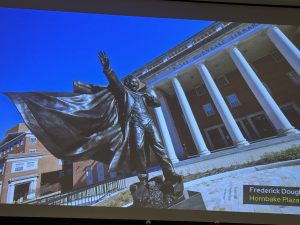
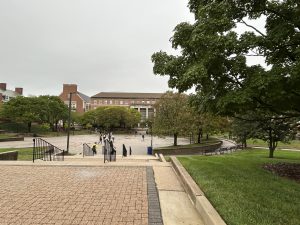
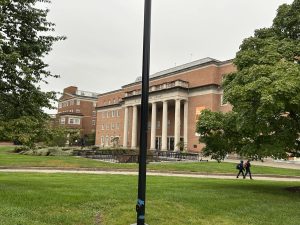
I dropped a few campus photos below, some I took at the Counselor Day. The photo up top is McKeldin Mall.

 A
All freshmen are guaranteed housing.
The university accommodates 90% of the freshman class, and about 40% of the undergraduate student body, with on-campus housing. This is reasonably high for a flagship state university. The university makes suggestions for a four-year housing plan. Luxury apartment buildings are sprouting up around the main campus gates off Route 1. So, off-campus rents are quite expensive for a college town.
Maryland also has a true fraternity row.
Organized as a horseshoe, fraternity and sorority houses may be either university owned or chapter owned.. St. Elmo’s Fire starring Rob Lowe and Demi Moore was filmed here in 1984; the horseshoe was meant to be the fraternity row at Georgetown, a school that has neither fraternities nor sororities. Greek life attracts 9% of undergraduate men and 12% of the women according to the university’s 2025-26 Common Data Set.
Maryland is a sports school but not really a football school.
The Maryland Terrapins play 20 sports as a member of the Big Ten. Since joining the conference in 2014 the Terps have had successes in Men’s and Women’s Basketball, Field Hockey, Men’s and Women’s Lacrosse and Men’s Soccer. Football has not been a strength since the move into the Big Ten. The Terrapins have played in five bowl games since joining the conference, winning three.
The Xfinity Center is one of the nicer indoor sports venues in the U.S. It hosted national champions in men’s basketball in 2002 and women’s basketball in 2006. The Cole Center, now used mainly for non-athletic purposes, hosted the 1966 NCAA National Championship game, the first that featured a team (Texas Western, now the University of Texas-El Paso) with an all-black starting lineup. Six other upsets of #1-ranked men’s basketball teams happened at Cole, all wins by Maryland.
Conclusions
Anyone who can gain admission and would like to knock on doors in Washington D.C. would be hard pressed to find a better value. than the University of Maryland-College Park. Through its various various academic outlets such as the learning communities, the university really tries to make a large school feel smaller than it actually is.
Report Card: University of Maryland-College Park
- Four-Year/Six-Year Graduation Rates: A
- Freshman Retention: A
- Costs: A Residents/B Non-Residents
- Curriculum: A
- Community: B+
- Comforts: B+
- Connections: A

