Meet Peter Pitts, The ‘Small College Guy’
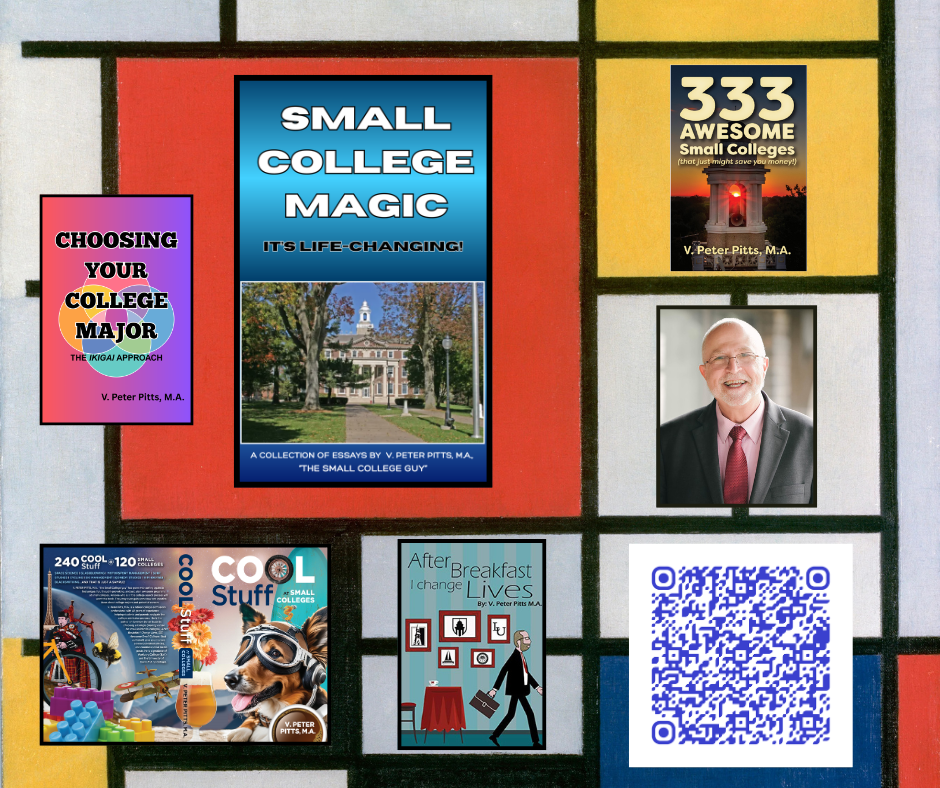
Peter Pitts, like me, writes about colleges. Only his special focus is on smaller colleges that are not as well known to families and counselors. A former regional director of admissions at Monmouth College (IL), a school that I covered here, Peter has become a prolific author about small colleges in his retirement. The photo up top shows his books, which I recommend to readers who are new to the college search.
I asked Peter of he would talk with me about small colleges. He graciously agreed. I invite you to listen to our conversation.
Peter considers a “small college” to be a school that has no more than 3,500 students. Many schools enroll close to this number though they might be dissimilar schools. Schools like Butler University (IN) and Drake University (IN) have fewer than 3,500 undergrads, though they also have graduate programs. Dartmouth does too, but it is a research focused institution. Others like Mount Holyoke are liberal arts colleges.
Peter’s greater focus is on schools that have between 700 and 1,500 students. He points out that many schools of this size that:
- Actually cost less than the regional public college, let alone a flagship state university, that’s close to home.
- Are financially viable, even in challenging times. This might be due to a unique academic model, spacial majors or a more personal touch towards education. Most of these schools focus on the bachelor’s degree. So, undergraduate students face no competition from graduate students for attention from professors and administrators.
- Have engaging residential campus cultures. However, they will be different from campus to campus, even within the same region or state.
- Face challenges based on location. Rural campuses are a harder sell today, as students seek urban and suburban schools close to larger cities,
As someone who writes about colleges of all sizes I agree for the need to devote more attention to smaller schools.
Colleges are not just places to “learn a trade.” They are also communities with not only a school but also many amenities that one finds in a city or town. These include housing, recreation, libraries, public safety and health & well being. Some colleges perform these services better than others. Smaller schools are better for students who seek or need more attention from teachers, among others. Those that have all majors under one administrative umbrella offer more academic flexibility.
During our conversation Peter pointed out that, for example, an engineering student could carry a second major in Philosophy, among other subjects. That’s much harder to do at a school that silos engineering and the liberal arts. Some also have unique majors that are tough to find anywhere. McPherson College (KS), a small college with an endowment in excess of $2 billion, is one example, offering a program in Auti Restoration.
Peter is a true believer that there is no “absolute best” school as represented in a college ranking.
Incoming and current students bring unique experiences, perspectives and interests to college. Some enter quite sure about their desired major and career; most do not. The undecided need more support and time from the school’s advisors and faculty. Smaller schools that recognize this, and have worked to define career paths and connections do this better than larger schools. As a graduate of two large public universities, I agree.
Listen to my conversation with Peter Pitts now!
Learn more about me!